
6.3.21. AI inversion reporting#
AI inversion reporting documents how a prediction was produced, where it is valid, how it was tested, and what decisions it may support. A resistivity section and a training-loss curve are not a complete report. The deliverable must connect the field survey to a versioned dataset, feature contract, model selection record, checkpoint, inference run, response reconstruction, uncertainty analysis, and scientific review.
This page focuses on AI-specific reporting. For the later geological and hydrogeophysical interpretation package, also use Export and reporting.
Separate prediction from interpretation
A network output is a model prediction. Geological labels, aquifer targets, and drilling recommendations are interpretations built from that prediction plus independent evidence. Report them in separate sections and preserve the transition from numerical result to professional judgment.
6.3.21.1. Reporting objectives#
An AI inversion package should allow a reviewer to answer:
Which field observations and processing revision were used?
Which feature transformation was applied?
Which synthetic or field data trained the model?
How were train, validation, calibration, and test examples separated?
Why was this model family and architecture selected?
Which exact checkpoint generated the prediction?
Was each field input inside the validated operating domain?
Does the predicted model reconstruct the observations?
Which uncertainty sources were quantified and which were omitted?
Which stations, profiles, or regions were accepted, flagged, or rejected?
What classical and independent evidence supports the result?
Who reviewed and approved the release?
6.3.21.2. Recommended reporting workflow#
assign stable IDs to dataset, model, checkpoint, and inference run;
freeze the structured numerical outputs before writing narrative;
generate dataset card and model card records;
report model-selection evidence and rejected candidates;
report training, calibration, synthetic test, and field validation results;
report input-domain status and per-station inference decisions;
report reconstructed response residuals and uncertainty;
state limitations, prohibited uses, and follow-up requirements;
assemble machine-readable artifacts, figures, and narrative;
perform scientific, ML, technical, and editorial review;
publish an immutable approved revision with a provenance manifest and checksums.
6.3.21.3. 1. Define report status and audience#
Use explicit status labels:
experimentalResearch output; architecture or dataset is still changing.
workingInternal project result not ready for independent review.
validation_candidateFrozen model submitted to the declared validation protocol.
reviewComplete candidate package awaiting scientific or technical approval.
approvedVersioned model and inference package accepted for its stated intended use.
supersededRetained for audit but no longer authoritative.
An approved model is approved only for the documented method, feature contract, survey conditions, output, and decision. Approval does not transfer automatically to another line, region, component, or acquisition system.
Tailor the summary to the audience, while keeping one authoritative technical appendix. A manager may need risk and decision language; a geophysicist needs residuals and dimensionality; an ML reviewer needs split and calibration evidence; a downstream interpreter needs units, axes, masks, and uncertainty.
6.3.21.4. 2. Use linked identifiers#
Use immutable identifiers for:
survey_idOriginal acquisition and station inventory.
processing_run_idQC, masks, corrections, components, and frequency selection.
dataset_idSynthetic/field examples, generator revision, feature/target contracts, and split indices.
model_selection_idCandidate comparison and declared selection rule.
training_run_idArchitecture, optimizer, seed, environment, history, and checkpoint output.
checkpoint_idExact artifact and checksum.
calibration_idConformal/posterior calibration dataset and state, where applicable.
inference_run_idField features, domain gates, predictions, residuals, and statuses.
report_package_idThis complete reviewed release.
A filename such as best_model.pkl is not a stable identifier. Include a
human-readable alias only in addition to a unique run/checkpoint ID.
6.3.21.5. 3. Recommended package structure#
L18_ai_inversion_20260712_r01/
├── README.md
├── manifest.yml
├── CHANGELOG.md
├── cards/
│   ├── dataset_card.md
│   └── model_card.md
├── provenance/
│   ├── environment.txt
│   ├── source_revisions.yml
│   └── checksums.sha256
├── configuration/
│   ├── data_generation.yml
│   ├── feature_contract.yml
│   ├── model.yml
│   ├── training.yml
│   └── inference.yml
├── checkpoints/
│   └── checkpoint_reference.yml
├── metrics/
│   ├── model_selection.csv
│   ├── training_history.csv
│   ├── synthetic_test.csv
│   ├── calibration.csv
│   ├── field_residuals.csv
│   └── robustness.csv
├── predictions/
│   ├── station_status.csv
│   ├── predicted_models.npz
│   └── output_schema.yml
├── uncertainty/
│   ├── intervals.npz
│   └── uncertainty_summary.csv
├── figures/
├── report/
│   ├── technical_report.md
│   └── technical_report.html
└── review/
    ├── comments.csv
    └── approval.yml
Store authoritative structured outputs separately from rendered reports. A PDF or HTML file is convenient for reading but unsuitable as the only source of prediction values.
6.3.21.6. 4. Write a dataset card#
The dataset card should describe both synthetic and field inputs.
- Purpose and scope
Intended inversion task, method, dimension, parameterization, target depth, and prohibited uses.
- Training distribution
Resistivity/thickness ranges, dependencies, geology scenarios, lateral correlation, rare targets, rejected samples, and sample count.
- Forward operator
Solver, dimension, frequencies/times, source geometry, numerical settings, approximations, and code version.
- Observation effects
Noise types and levels, missingness, outliers, static shift, source effects, coordinate perturbations, and augmentation probabilities.
- Feature contract
Names, order, units, transformations, grid, component convention, masks, imputation, and normalization.
- Target contract
Parameter order, shapes, units, log transformations, layer/depth axes, and padding/masks.
- Splits
Grouping policy, exact counts and indices, leakage controls, calibration role, and untouched test set.
- Field data
Survey/processing IDs, stations, components, frequency coverage, exclusions, corrections, and data-governance constraints.
- Known gaps
Physics, geology, noise, or geometry not represented.
The dataset card must travel with the checkpoint. A model cannot be reviewed without knowing the distribution it learned.
6.3.21.7. 5. Write a model card#
A model card should contain:
- Model identity
Name, version, checkpoint ID/checksum, code revision, backend, and status.
- Intended use
Supported method, dimension, survey conditions, output, users, and decision.
- Out-of-scope use
Unsupported components, grids, geology, geometry, depth, noise, or safety- critical decisions.
- Architecture
FCN/CNN/ResNet/U-Net/GCN/PINN/hybrid/joint/ensemble, parameterization, important hyperparameters, and architectural assumptions.
- Training
Dataset ID, optimizer, epochs, early stopping, regularization, seeds, hardware, precision, runtime, and selected checkpoint rule.
- Selection
Candidate set, primary metric, constraints, repeated-run statistics, and why rejected alternatives were not chosen.
- Evaluation
Synthetic model-space, response-space, structural, robustness, calibration, field, and operational metrics.
- Uncertainty
Method, calibration data, coverage, interval width, distribution-shift limitations, and omitted sources.
- Ethical and operational considerations
Data sensitivity, automation limits, human review, monitoring, and rollback.
- Limitations
Known failure cases, depth/resolution cautions, physics approximations, and domain boundaries.
6.3.21.8. 6. Report model selection#
Do not report only the winning architecture. Include a compact candidate table:
Candidate |
Dimension |
Synthetic test |
Response fit |
Calibration |
Decision |
|---|---|---|---|---|---|
FCN-5L |
1-D |
Reported metric |
Reported metric |
N/A or metric |
Rejected/accepted reason |
ResNet-5L |
1-D |
Reported metric |
Reported metric |
N/A or metric |
Selected reason |
PINN-2D |
pseudo-2-D |
N/A or scenario |
Reported metric |
Scenario spread |
Baseline/rejected reason |
State whether repeated seeds changed internal train/validation splits. Report means, spreads, failures, and tuning budget rather than the best run alone. See AI model selection for the complete protocol.
6.3.21.9. 7. Report training behavior#
For supervised models, retain per-epoch training and validation histories where
available. The inverter classes store training history internally, but there is
not one uniform public history_ property across every class. Agent results
may expose train_history or loss_df; PINN classes expose methods such as
convergence_curve(). Use the documented interface for the selected class
and store the underlying numeric table, not only the plotted curve.
Report:
requested and completed epochs;
batch size, optimizer, learning rate, and scheduling;
early-stopping rule and selected epoch;
training/validation losses and their definitions;
augmentation and regularization;
all seeds and number of repeated runs;
backend, device, precision, and runtime;
interrupted, failed, or restarted runs;
checkpoint selection rule.
For PINN/hybrid runs, report observation-specific optimization, total loss, physics and regularization terms where available, learning-rate/epoch sensitivity, initialization, and convergence limitations. A PINN convergence curve is not a supervised validation curve.
6.3.21.10. 8. Report test metrics in context#
Model-space metrics#
For each model-space metric, state whether values represent log10 resistivity, linear resistivity, thickness, boundary depth, or a section. Include units, aggregation, and depth or scenario stratification.
Response-space metrics#
For each response-space metric, state:
forward operator;
apparent resistivity, phase, impedance, or decay channels;
log/linear residual space;
observational errors and weights;
frequency/time mask;
station/component aggregation.
If the observed data vector is \(\mathbf d_{\mathrm{obs}}\) and the response reconstructed from the prediction is \(F(\hat{\mathbf m})\), a weighted residual should state the weighting:
Do not label an unweighted log-apparent resistivity RMS misfit as a full impedance tensor RMS.
Build structured evidence#
The current pycsamt.ai.validation package turns several required report
tables into immutable, labeled result objects. This is preferable to copying a
number from a plotting function because the aggregation, valid count, shape,
and axis breakdowns remain available for serialization and review.
response_residual_reportAccepts canonical complex impedance arrays with shape
(station,
frequency, component)
and reports the same L1/L2 penalty overall and by each axis. Positive errors normalize the complex residual before reduction.response_residual_report_from_contractsApplies the same calculation directly to an aligned
pycsamt.forward.maxwell.ForwardResultandpycsamt.ai.data.SurveyData, retaining station, frequency, and component labels.recovery_reportReports masked RMSE, MAE, \(R^2\), optional structural similarity, and recovery by depth for a known-truth 2-D or 3-D synthetic grid. It is not a field-truth metric.
flag_out_of_distributionReturns per-input Mahalanobis or k-nearest-neighbour scores, the declared or reference-derived threshold, and the complete flag vector. Flagged rows are retained rather than deleted.
The following small example captures the exact public outputs:
>>> import numpy as np
>>> from pycsamt.ai.validation import (
...     flag_out_of_distribution,
...     recovery_report,
...     response_residual_report,
... )
>>> predicted = np.array([[[1 + 0j], [2 + 0j]], [[0j], [0j]]])
>>> observed = np.array([[[1 + 0j], [0j]], [[0j], [3 + 0j]]])
>>> residual = response_residual_report(
...     predicted,
...     observed,
...     station_names=("S1", "S2"),
...     frequencies_hz=(10.0, 1.0),
...     components=("zxy",),
... )
>>> residual.shape, residual.overall.value, residual.overall.n_valid
((2, 2, 1), 3.25, 4)
>>> residual.by_station.tolist(), residual.by_frequency.tolist()
([2.0, 4.5], [0.0, 6.5])

>>> true_model = np.array([[1.0, 2.0], [3.0, 6.0]])
>>> predicted_model = np.array([[1.0, 2.0], [3.0, 4.0]])
>>> recovery = recovery_report(
...     predicted_model, true_model, compute_ssim=False
... )
>>> round(recovery.rmse, 3), round(recovery.mae, 3)
(1.0, 0.5)
>>> recovery.depth_rmse.round(3).tolist()
[0.0, 1.414]

>>> reference = np.array([
...     [0.0, 0.0], [1.0, 0.0], [0.0, 1.0],
...     [-1.0, 0.0], [0.0, -1.0], [0.5, 0.5],
... ])
>>> field = np.array([[0.0, 0.0], [50.0, 50.0]])
>>> domain = flag_out_of_distribution(
...     field, reference, method="knn", k=2, quantile=0.5
... )
>>> domain.flagged.tolist(), domain.threshold, domain.fraction_flagged
([False, True], 1.0, 0.5)
For kind="l2", the response report axis arrays contain mean squared
normalized residuals, not their square roots. If a report presents RMS, take
the square root explicitly and preserve the original penalty table so equation
(1) remains auditable.
Structural and decision metrics#
Report conductor-top error, anomaly detection, section overlap, target ranking, or other decision metrics only when their definitions and tolerances were declared before model selection.
Performance slices#
Include results by:
resistivity and thickness range;
layer/depth;
geology scenario;
noise and missingness level;
station density or graph degree;
in-domain versus near-boundary inputs;
known rare or difficult targets.
One aggregate test score can conceal operationally unacceptable failure.
6.3.21.11. 9. Report field-domain status#
Every inference station or profile should have a station status table:
station,feature_finite_pct,ood_score,domain_status,prediction_status,reason
S00,100.0,0.12,inside,accepted,
S01,93.8,0.41,near_boundary,needs_review,missing_high_frequency_band
S02,71.9,0.88,outside,rejected,unsupported_frequency_coverage
Document the domain method and threshold. A marginal percentile envelope, latent distance, density estimate, or ensemble disagreement score has different meaning. Do not call all of them probability.
Keep rejected rows. Removing them makes the prediction set look more complete and breaks traceability to the survey inventory.
6.3.21.12. 10. Report predictions with an output schema#
For layered 1-D or graph output, include:
station identifier and order;
layer index;
resistivity in linear ohm metres and/or explicitly named log10 form;
thickness in metres;
cumulative interface depth;
accepted/review/rejected status;
clipping or bound flags;
checkpoint and inference IDs.
For 2-D output, include:
profile and station axes;
physical chainage;
layer or depth axis;
whether thickness varies by station;
resistivity transformation and unit;
missing/rejected columns;
whether the section is supervised U-Net, pseudo-2-D PINN, or hybrid.
For graph output, additionally include coordinates, CRS, adjacency/radius, degree, connected component, and whether a later volume was interpolated from node predictions.
NPZ is useful for trusted arrays, while CSV is useful for audit. Accompany both with a schema. Do not require a reviewer to infer array axes from code.
6.3.21.13. 11. Report response reconstruction#
Preserve reconstructed responses and residuals per station, frequency/time, and component. A useful table contains:
station,frequency_hz,component,rho_obs_ohm_m,rho_pred_ohm_m,
phase_obs_deg,phase_pred_deg,valid,error_rho,error_phase
Summaries should include distributions, not only one global mean. Plot residual heatmaps and curves with consistent scales. Flag structured residuals associated with dimensionality, source effects, bad bands, station gaps, or out-of-domain inputs.
For PINN 2-D, explicitly state that response physics are per-station MT1D with lateral model smoothing. For supervised 2-D and graph workflows, state the forward physics used to generate training examples separately from the forward operator used for field reconstruction.
6.3.21.14. 12. Report uncertainty and calibration#
State the method:
- Ensemble spread
Member construction, number of members, seeds/architectures, raw standard deviation, and shared-bias limitation.
- MC dropout
Dropout rate, stochastic pass count, parameter space, and missing structural uncertainty.
- Conformal intervals
Calibration set ID/size,
alpha, empirical untouched-test coverage, interval width, and exchangeability limitation.- Posterior calibration
Calibration inputs, base mean/spread, draw count, random generator, and interpretation of samples.
- Scenario spread
PINN/hybrid/classical configurations, data perturbations, accepted scenario criteria, and aggregation grid.
Report calibration and sharpness together. A very wide interval can achieve coverage without supporting a useful decision. A narrow interval can be wrong under field domain shift.
Warning
EnsembleInverter.save() preserves members, estimator count, and seeds,
but does not serialize attached conformal or posterior calibrators. A report
must reference the calibration dataset and restoration procedure separately;
loading the ensemble alone does not restore calibrated inference.
The following controlled dashboard is generated entirely from
RecoveryReport,
ResponseResidualReport,
OODReport, and
ReliabilityCurve. Its arrays are synthetic and
illustrative; the figure demonstrates report composition, not pyCSAMT model
performance.
View structured reporting-dashboard source codeClick to inspect and copy the complete code
 1def make_reporting_validation_dashboard() -> None:
 2    """Build one dashboard entirely from structured validation reports."""
 3    rng = np.random.default_rng(73)
 4
 5    depth = np.linspace(0, 1800, 24)
 6    x = np.linspace(0, 1, 32)
 7    truth = 2.5 + 0.8 * np.exp(-((depth[:, None] - 850) / 260) ** 2)
 8    truth = truth - 1.5 * np.exp(-((x[None, :] - 0.55) / 0.16) ** 2) * np.exp(
 9        -((depth[:, None] - 650) / 330) ** 2
10    )
11    prediction = truth + rng.normal(0, 0.08 + depth[:, None] / 9000, truth.shape)
12    recovery = recovery_report(prediction, truth, depth_axis=0)
13
14    n_station, n_frequency, n_component = 12, 18, 2
15    observed = rng.normal(size=(n_station, n_frequency, n_component)) + 1j * rng.normal(
16        size=(n_station, n_frequency, n_component)
17    )
18    error = np.full(observed.shape, 0.12)
19    bias = np.linspace(0.02, 0.22, n_station)[:, None, None]
20    predicted = observed + bias + 1j * rng.normal(0, 0.06, observed.shape)
21    residual = response_residual_report(
22        predicted, observed, errors=error, kind="l2",
23        station_names=[f"S{i:02d}" for i in range(n_station)],
24        frequencies_hz=np.logspace(3, -1, n_frequency),
25        components=("zxy", "zyx"),
26    )
27
28    reference = rng.normal(0, 1, (160, 2))
29    field = np.vstack([rng.normal(0, 0.8, (8, 2)), [[3.4, 3.0], [-3.2, 2.8]]])
30    ood = flag_out_of_distribution(
31        field, reference, method="mahalanobis", quantile=0.95
32    )
33
34    y_true = rng.normal(size=500)
35    y_mean = y_true + rng.normal(0, 0.45, y_true.shape)
36    y_std = np.full(y_true.shape, 0.38)
37    calibration = reliability_curve(y_true, y_mean, y_std)
38
39    fig, axes = plt.subplots(2, 2, figsize=(12.2, 8.0))
40    ax_depth, ax_residual, ax_ood, ax_calibration = axes.ravel()
41    ax_depth.plot(recovery.depth_rmse, depth, color="#f15a29", lw=2, label="RMSE")
42    ax_depth.plot(recovery.depth_mae, depth, color="#3e65b0", lw=2, label="MAE")
43    ax_depth.invert_yaxis()
44    ax_depth.set(
45        xlabel=r"Log-resistivity error ($\log_{10}\Omega$ m)",
46        ylabel="Depth (m)", title="Synthetic recovery by depth",
47    )
48    ax_depth.grid(alpha=0.22)
49    ax_depth.legend(frameon=False)
50
51    ax_residual.bar(
52        np.arange(n_station), residual.by_station,
53        color="#3e65b0", alpha=0.82,
54    )
55    ax_residual.set(
56        xlabel="Station index", ylabel="Mean squared normalized residual",
57        title="Response residuals retain axis structure",
58    )
59    ax_residual.grid(axis="y", alpha=0.22)
60
61    colors = np.where(ood.flagged, "#f15a29", "#3e65b0")
62    ax_ood.bar(np.arange(len(ood.scores)), ood.scores, color=colors)
63    ax_ood.axhline(
64        ood.threshold, color="#111827", ls="--", lw=1.4,
65        label=f"95% reference threshold = {ood.threshold:.2f}",
66    )
67    ax_ood.set(
68        xlabel="Field sample", ylabel="Mahalanobis score",
69        title="Domain gate preserves rejected rows",
70    )
71    ax_ood.legend(frameon=False, fontsize=8)
72    ax_ood.grid(axis="y", alpha=0.22)
73
74    ax_calibration.plot([0, 1], [0, 1], color="#111827", ls="--", label="ideal")
75    ax_calibration.plot(
76        calibration.levels, calibration.coverage,
77        color="#f15a29", marker="o", lw=2, label="empirical",
78    )
79    ax_calibration.set(
80        xlim=(0.45, 1.0), ylim=(0.45, 1.0),
81        xlabel="Nominal coverage", ylabel="Empirical coverage",
82        title=f"Calibration and sharpness ({calibration.sharpness:.2f})",
83    )
84    ax_calibration.grid(alpha=0.22)
85    ax_calibration.legend(frameon=False)
86
87    fig.suptitle("Machine-readable evidence behind an AI inversion report")
88    fig.tight_layout()
89    _save(fig, "reporting_validation_dashboard.png")
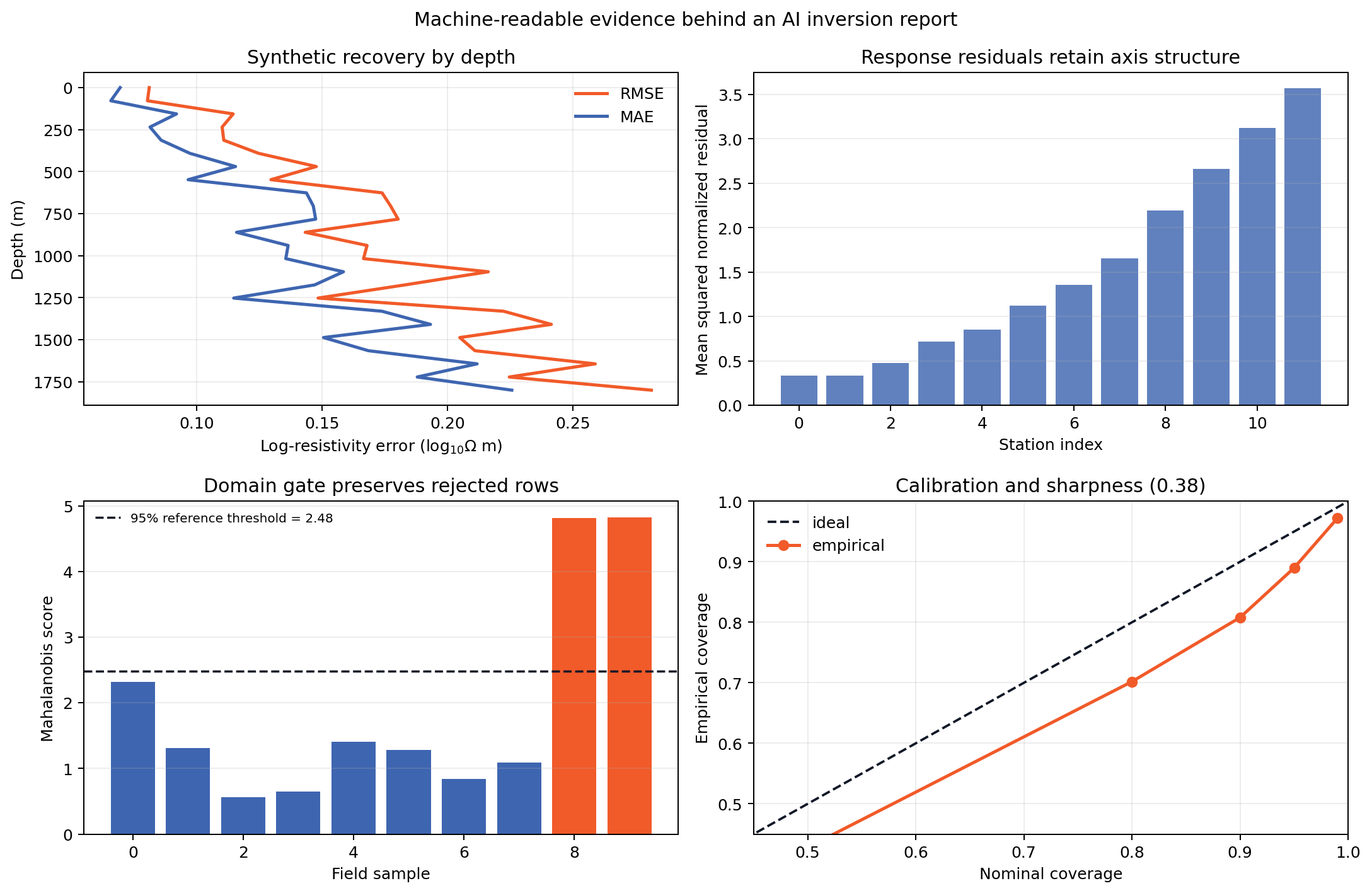
Recovery degrades with depth in this constructed case, while the response panel exposes a station-dependent bias that one global mean would hide. The domain panel keeps two rejected samples visible above the predeclared threshold. The reliability curve lies below the ideal diagonal, revealing under-coverage; its sharpness value cannot compensate for that calibration failure. A defensible report preserves these numerical objects alongside the rendered dashboard.#
6.3.21.15. 13. Report classical and independent validation#
Include comparisons with an appropriate baseline:
built-in or conventional 1-D inversion;
Occam2D for defensible line geometry;
ModEM or MARE2DEM where appropriate;
boreholes, laboratory measurements, mapped geology, or other geophysics;
withheld field responses or sites.
State which evidence was used in training, tuning, calibration, interpretation, and final validation. Evidence cannot be called independent after it influenced model or threshold selection.
Report disagreement rather than averaging it away. Explain whether it suggests non-uniqueness, wrong dimension, domain shift, data error, or geological ambiguity.
6.3.21.16. 14. Report figures responsibly#
Minimum useful figures include:
synthetic parameter and response distributions;
field-versus-training coverage;
training/validation or PINN convergence;
synthetic test predictions versus truth;
observed and reconstructed field responses;
residuals by station/frequency/component;
prediction section or layered profiles;
uncertainty intervals or maps;
classical/model comparison;
station status and rejected inputs.
Every figure should identify model/checkpoint, dataset, run, axes, units, transformations, missing data, status, and color scale. Use fixed scales across model comparisons. A smooth color image must not hide station spacing or rejected columns.
For varying-thickness layered sections, do not plot layer index as depth. Build interface depths and resample to a physical grid while retaining original layered values.
6.3.21.17. 15. Use ReportAgent carefully#
pycsamt.agents.ReportAgent can assemble selected agent results into a
survey-level Markdown report and optional HTML:
>>> from pathlib import Path
>>> from pycsamt.agents import AgentResult, ReportAgent

>>> load_result = AgentResult(
...     status="success",
...     summary="Loaded 28 stations.",
...     data={
...         "n_stations": 28,
...         "summary_stats": {
...             "global_t_min_s": 0.001,
...             "global_t_max_s": 1000.0,
...             "mean_qc_score": 87.0,
...         },
...     },
... )
>>> qc_result = AgentResult(
...     status="success",
...     summary="QC accepted 24 stations.",
...     data={
...         "n_flagged": 4,
...         "flagged_stations": ["18-013U", "18-021B"],
...     },
...     warnings=["4 stations require review"],
... )
>>> ai_result = AgentResult(
...     status="success",
...     summary="AI inversion accepted 24 stations.",
...     data={"accepted": 24, "needs_review": 3, "rejected": 1},
... )

>>> reporter = ReportAgent(
...     api_key="",
...     report_title="L18 AI inversion review",
...     formats=["md"],
... )

>>> report_result = reporter.execute({
...     "results": {
...         "load": load_result,
...         "qc": qc_result,
...         "ai_inversion": ai_result,
...     },
...     "output_dir": "tmp_reporting_agent",
... })

>>> print(report_result["report_path_md"])
tmp_reporting_agent\survey_report.md
>>> print(report_result.warnings)
[]
>>> print(Path(report_result["report_path_md"]).exists())
True
The current implementation has predefined narrative sections for loading, QC,
static shift, phase analysis, forward modeling, and recommendations. It copies
figure paths from AgentResult objects, but it does not provide a dedicated
AI model-card section or serialize full prediction/uncertainty arrays.
Markdown is always attempted. HTML requires the optional markdown package.
Although the module documentation mentions PDF as an intended format, the
current execute() implementation does not generate or return a PDF path.
Do not promise PDF output from this agent without an additional tested step.
The api_key="" argument keeps this example offline and deterministic. Use
ReportAgent as a draft survey-report assembler, not as the complete AI
governance package described on this page.
The offline fallback recommendation text is generic: it can recommend profile-oriented 2-D inversion and static-shift correction even when the input results do not establish those choices. Treat it as drafting text only. Replace or approve every recommendation from structured dimensionality, correction, inversion, and validation evidence; successful report generation is not scientific approval.
6.3.21.18. 16. Handle optional LLM narrative#
AI agents can return llm_interpretation when configured with a provider.
Report generated text only after human verification.
The narrative must not introduce:
station counts or metrics absent from structured outputs;
geological labels without independent evidence;
claims of uniqueness or certainty;
unsupported depth precision;
hidden recommendations not approved by the reviewer;
confidential data sent to an unauthorized external service.
Store generated text separately from approved conclusions, along with provider, model, prompt context policy, timestamp, estimated cost, reviewer, and edits. The structured numerical artifacts remain authoritative.
6.3.21.19. 17. Write the narrative report#
A detailed AI inversion report should contain:
- Executive summary
Intended decision, selected model, accepted coverage, principal prediction, uncertainty, limitations, and next action.
- Survey and processing
Acquisition, station inventory, QC, components, masks, corrections, dimensionality, and source run IDs.
- AI inversion concept
Supervised/PINN/hybrid approach, physical dimension, parameterization, and relationship to classical inversion.
- Data preparation
Synthetic generator, forward physics, noise, features, targets, splits, normalization, and field-domain comparison.
- Model selection and training
Candidates, declared metrics, selected architecture, hyperparameters, repeated runs, checkpoint, and compute environment.
- Validation
Synthetic test, response reconstruction, robustness, calibration, field evidence, failure cases, and acceptance thresholds.
- Inference
Field feature replay, domain gates, station statuses, predictions, clipping, residuals, and runtime.
- Uncertainty
Quantified sources, coverage and intervals, distribution shift, scenario spread, and omitted sources.
- Interpretation
Separate evidence-based geological meaning, alternatives, and confidence.
- Limitations and intended use
Unsupported conditions, prohibited uses, monitoring triggers, and review requirements.
- Conclusions and recommendations
Decision-focused conclusions conditional on the documented evidence.
6.3.21.20. 18. Build a machine-readable manifest#
schema_version: 1
report_package_id: L18_ai_inversion_20260712_r01
status: review
survey_id: willy_L18_acquisition_v01
processing_run_id: L18_processing_r03
dataset_id: mt1d_5layer_v001
model_selection_id: L18_model_selection_r01
training_run_id: mt1d_resnet_seed42_r01
checkpoint:
  id: mt1d_resnet_5l_ckpt_r01
  path: external_or_controlled_checkpoint_reference
  sha256: replace_with_verified_checksum
feature_contract:
  component: xy
  n_frequencies: 32
  frequency_unit: Hz
  layout: log10_rho_block_then_phase_deg_block
inference_run_id: L18_inference_r01
prediction:
  resistivity_unit: ohm_m
  thickness_unit: m
  accepted_stations: 24
  needs_review_stations: 3
  rejected_stations: 1
uncertainty:
  method: ensemble_conformal
  interval: P05_P95
  calibration_id: mt1d_calibration_v001
software:
  package: pycsamt
  version: 2.0.0
review:
  scientific_status: pending
  ml_status: pending
Use relative paths and checksums where files are inside the package. Do not place API keys, credentials, personal information, or machine-specific absolute paths in the manifest.
6.3.21.21. 19. Validate the report package#
- Structural validation
Required cards, configuration, metrics, predictions, manifest, and review records exist and are non-empty.
- Schema validation
Array axes, CSV fields, units, transformations, null values, and IDs match the declared schema.
- Numerical validation
Prediction arrays match figures; log/linear conversion round-trips; thicknesses and resistivities are positive; intervals are ordered; station counts reconcile with the source inventory.
- Provenance validation
Checkpoint checksum, dataset/model IDs, code version, and configuration references resolve correctly.
- Scientific validation
Conclusions match structured results, response residuals, uncertainty, classical comparisons, and accepted/rejected statuses.
- Reproduction validation
A clean approved environment can load the artifact, replay preprocessing, reproduce a small reference prediction, and match within tolerance.
- Security validation
Checkpoints are trusted, external-service use was authorized, and the package contains no credentials or unintended sensitive information.
6.3.21.22. 20. Review and approval roles#
- Geophysical review
Physics, dimensionality, response fit, classical comparison, depth, and geological plausibility.
- ML review
Dataset, leakage, architecture selection, training, calibration, robustness, domain shift, and checkpoint reproducibility.
- Software review
API contracts, units, shapes, persistence, environment, tests, and package integrity.
- Interpretation review
Independent evidence, alternatives, confidence, and decision language.
- Governance approval
Intended use, release status, privacy, revision, and downstream notification.
Record comments and dispositions. A material change to data, preprocessing, checkpoint, calibration, domain gate, or conclusion requires a new revision and revalidation of dependent artifacts.
6.3.21.23. 21. Monitor deployed models#
Reporting does not end at initial approval. Define monitoring for:
feature-distribution and missingness drift;
new acquisition or processing versions;
station geometry outside the validated domain;
response residual degradation;
uncertainty or ensemble-disagreement increase;
repeated review/rejection patterns;
new boreholes or classical inversions that contradict predictions;
backend or dependency changes affecting numerical output.
Specify retraining, recalibration, rollback, and reapproval triggers. Preserve the prior approved package when issuing a replacement.
6.3.21.24. Complete reporting skeleton#
The following code writes core structured inference products. It assumes the arrays and statuses have already been validated:
>>> from pathlib import Path
>>> import csv
>>> import json
>>> import numpy as np

>>> root = Path("tmp_L18_ai_inversion_20260712_r01")
>>> predictions_dir = root / "predictions"
>>> metrics_dir = root / "metrics"
>>> predictions_dir.mkdir(parents=True, exist_ok=True)
>>> metrics_dir.mkdir(parents=True, exist_ok=True)

>>> station_names = np.asarray(["S00", "S01", "S02"])
>>> resistivity_ohm_m = np.asarray([
...     [120.0, 80.0, 35.0],
...     [100.0, 65.0, 30.0],
...     [90.0, 55.0, 25.0],
... ])
>>> thickness_m = np.asarray([
...     [40.0, 120.0],
...     [35.0, 115.0],
...     [30.0, 110.0],
... ])
>>> accepted_mask = np.asarray([True, False, False])
>>> review_mask = np.asarray([False, True, False])
>>> status_reasons = [
...     "",
...     "missing_high_frequency_band",
...     "unsupported_frequency_coverage",
... ]

>>> np.savez_compressed(
...     predictions_dir / "predicted_models.npz",
...     station_names=station_names,
...     resistivity_ohm_m=resistivity_ohm_m,
...     thickness_m=thickness_m,
...     accepted=accepted_mask,
...     needs_review=review_mask,
... )

>>> status_rows = []
>>> for index, name in enumerate(station_names):
...     if accepted_mask[index]:
...         status = "accepted"
...     elif review_mask[index]:
...         status = "needs_review"
...     else:
...         status = "rejected"
...     status_rows.append({
...         "station": str(name),
...         "prediction_status": status,
...         "reason": status_reasons[index],
...     })

>>> with (predictions_dir / "station_status.csv").open(
...     "w", newline="", encoding="utf-8"
... ) as stream:
...     writer = csv.DictWriter(
...         stream,
...         fieldnames=["station", "prediction_status", "reason"],
...     )
...     writer.writeheader()
...     writer.writerows(status_rows)

>>> manifest = {
...     "report_package_id": "L18_ai_inversion_20260712_r01",
...     "status": "review",
...     "dataset_id": "mt1d_5layer_v001",
...     "checkpoint_id": "mt1d_resnet_5l_ckpt_r01",
...     "inference_run_id": "L18_inference_r01",
...     "n_stations": len(station_names),
...     "accepted": int(np.sum(accepted_mask)),
...     "needs_review": int(np.sum(review_mask)),
...     "rejected": int(np.sum(~accepted_mask & ~review_mask)),
...     "resistivity_unit": "ohm_m",
...     "thickness_unit": "m",
... }
>>> (root / "manifest.json").write_text(
...     json.dumps(manifest, indent=2),
...     encoding="utf-8",
... )
335
>>> print(sorted(p.name for p in predictions_dir.iterdir()))
['predicted_models.npz', 'station_status.csv']
>>> print(manifest["accepted"], manifest["needs_review"], manifest["rejected"])
1 1 1
This skeleton does not replace dataset/model cards, checksums, response residuals, uncertainty, figures, narrative, or approval records.
6.3.21.25. Release checklist#
Check |
Acceptance evidence |
|---|---|
Scope and status are explicit |
Intended use, prohibited use, audience, revision, and approval state. |
IDs connect the lineage |
Survey, processing, dataset, selection, training, checkpoint, calibration, inference, and report IDs. |
Dataset card is complete |
Priors, physics, noise, features, targets, splits, field data, and gaps. |
Model card is complete |
Architecture, training, selection, metrics, limitations, and deployment. |
Checkpoint is identifiable |
Trusted path/reference, checksum, backend, compatibility, and status. |
Metrics are contextual |
Definitions, units, aggregation, scenarios, repeated runs, and failures. |
Field domain is visible |
Per-station/profile score, threshold, accepted/review/rejected status. |
Responses are reconstructed |
Forward operator, component, weighting, residual tables, and patterns. |
Uncertainty is calibrated conditionally |
Method, calibration ID, coverage, sharpness, shift, and omitted sources. |
Interpretation is separate |
Evidence, alternatives, confidence, and responsible reviewer. |
Package is reproducible |
Configurations, environment, arrays, schemas, manifest, and reference prediction. |
Release is controlled |
Checksums, comments, approvals, changelog, immutable archive, and monitoring triggers. |
6.3.21.26. Common reporting mistakes#
Avoid these errors:
reporting only a prediction figure and global RMS;
omitting the dataset or feature contract from the model record;
naming one run
bestwithout reporting the selection process;presenting synthetic test accuracy as field validation;
hiding rejected stations or model failures;
confusing log10 and linear resistivity or thickness;
losing station order or graph geometry in exports;
calling U-Net/GCN/PINN output full 2-D/3-D physics without qualification;
reporting ensemble or dropout spread as total uncertainty;
claiming conformal field coverage from shifted synthetic calibration;
assuming a saved ensemble retains uncertainty calibrators;
treating LLM text as an authoritative scientific result;
promising PDF output from
ReportAgentwhen its current execution path produces Markdown and optional HTML only;changing preprocessing or thresholds without revising the model package;
approving a checkpoint without a trusted checksum and reproducibility test.
6.3.21.27. Next steps#
Use this page with:
AI inversion data preparation for the dataset card source;
AI model selection for candidate and decision evidence;
Training AI inversion models for training-run provenance;
AI inversion validation for acceptance metrics and field evidence;
AI inversion inference for station-level status and structured predictions;
AI inversion uncertainty for calibration and distribution shift;
AI inversion agents for
AgentResultand report orchestration;Export and reporting for downstream interpretation delivery.