
9.10. Power Management#
Power management estimates whether field IoT nodes can survive the
planned deployment. The pycsamt.iot.power helpers combine
battery capacity, energy reserve, active/sleep
duty cycle, regulator efficiency, telemetry window
energy, edge-processing overhead, auxiliary load, and
optional solar harvesting into one runtime estimate per device.
Visualization already showed plot_power_budget()
reading one node’s numbers off a chart; this page derives those same
numbers from first principles.
The examples below use synthetic L18-style field nodes. That is the right level for this page because power budget calculations depend on device operations, not EDI impedance files. The three scenarios represent a solar-assisted node, a marginal node with high telemetry demand, and a critical node with small battery capacity and no harvesting.
9.10.1. Building Device Power Profiles#
Use DevicePowerProfile when several field
nodes share the same recorder hardware. The profile stores hardware
draw; each EnergyConfig stores
deployment-specific conditions — the same active/sleep power figures
turn into three very different budgets once battery size, duty cycle,
and harvest differ.
>>> from pycsamt.iot import DevicePowerProfile
>>> profile = DevicePowerProfile(
...     "amt-recorder", active_power_w=1.6, sleep_power_w=0.12,
...     telemetry_power_w=3.0, edge_power_w=0.35,
... )
>>> configs = [
...     profile.apply(
...         battery_wh=160.0, duty_cycle=0.35, solar_wh_per_day=38.0,
...         charge_efficiency=0.85, reserve_fraction=0.20,
...         regulator_efficiency=0.88, telemetry_seconds_per_day=420.0,
...         edge_duty_cycle=0.35, auxiliary_wh_per_day=1.5,
...         min_runtime_days=7.0, device_id="l18-node-01",
...     ),
...     profile.apply(
...         battery_wh=95.0, duty_cycle=0.55, solar_wh_per_day=8.0,
...         charge_efficiency=0.80, reserve_fraction=0.20,
...         regulator_efficiency=0.85, telemetry_seconds_per_day=900.0,
...         edge_duty_cycle=0.55, auxiliary_wh_per_day=2.0,
...         min_runtime_days=7.0, device_id="l18-node-02",
...     ),
...     profile.apply(
...         battery_wh=48.0, duty_cycle=0.85, solar_wh_per_day=0.0,
...         reserve_fraction=0.15, regulator_efficiency=0.82,
...         telemetry_seconds_per_day=1500.0, edge_duty_cycle=0.80,
...         auxiliary_wh_per_day=3.0, min_runtime_days=7.0,
...         device_id="l18-node-03",
...     ),
... ]
>>> print([cfg.device_id for cfg in configs])
['l18-node-01', 'l18-node-02', 'l18-node-03']
l18-node-03 is already the one to watch: the smallest battery, the
highest duty cycle, the longest telemetry window, and no solar input at
all — every knob turned toward higher risk at once, deliberately, so the
rest of this page has a clear worst case to trace through.
9.10.2. Estimate One Device#
Use estimate_energy_budget() for a single
device. The estimate reports daily load, daily harvest, net daily draw,
runtime, state, and machine-readable issues. The calculation starts by
holding back the reserved battery energy,
where \(r\) is reserve_fraction. The active/sleep duty cycle
gives the base average power,
Daily load is then the regulator-corrected base draw plus radio, edge-processing, and auxiliary loads:
Usable daily harvest is \(E_\mathrm{harvest/day}=E_\mathrm{solar/day}\eta_\mathrm{charge}\), so the net daily draw is
If \(E_\mathrm{net/day} \le 0\), runtime is infinite in the idealised budget because harvest covers the daily load. Otherwise,
pyCSAMT also reports no-harvest autonomy, \(E_\mathrm{usable}/E_\mathrm{load/day}\), so a solar-assisted station still has a clear fallback runtime for cloudy periods or panel failure — that denominator is the full daily load, not the harvest-offset net draw, so autonomy is always the more conservative of the two runtime numbers whenever harvest is nonzero.
>>> from pycsamt.iot import estimate_energy_budget, power_summary_table
>>> estimate = estimate_energy_budget(configs[1])
>>> table = power_summary_table(estimate, device_ids=[configs[1].device_id])
>>> print(
...     table[
...         ["device_id", "state", "runtime_days", "load_wh_per_day",
...          "harvest_wh_per_day", "net_wh_per_day",
...          "energy_margin_wh_per_day", "issues"]
...     ].to_string(index=False)
... )
  device_id    state  runtime_days  load_wh_per_day  harvest_wh_per_day  net_wh_per_day  energy_margin_wh_per_day                                     issues
l18-node-02 critical       2.77963        33.741765                 6.4       27.341765                -27.341765 daily_energy_deficit;runtime_below_minimum
l18-node-02’s 8 Wh/day of solar, scaled by an 80% charge efficiency,
only offsets 6.4 of its 33.7 Wh/day load — nowhere near enough to reach
sustaining, so the net draw of 27.3 Wh/day against its 76 Wh usable
battery (95 Wh minus a 20% reserve) gives the 2.78-day runtime shown.
Both configured issues fire together here: the deficit itself, and a
runtime that falls well short of the 7-day min_runtime_days.
9.10.3. Estimate A Deployment#
Use estimate_deployment_energy() when several
nodes must be compared. runtime_days is infinite when daily harvest
is greater than or equal to daily load. The state column is a
compact power state: sustaining when harvest covers load,
ok when runtime reaches the configured minimum, warning when
runtime is at least half of the minimum, and critical below that.
>>> from pycsamt.iot import estimate_deployment_energy
>>> deployment = estimate_deployment_energy(configs)
>>> print(
...     deployment[
...         ["device_id", "state", "runtime_days", "autonomy_days_no_harvest",
...          "load_wh_per_day", "harvest_wh_per_day", "net_wh_per_day", "issues"]
...     ].copy().round(
...         {"runtime_days": 2, "autonomy_days_no_harvest": 2,
...          "load_wh_per_day": 2, "harvest_wh_per_day": 2, "net_wh_per_day": 2}
...     ).to_string(index=False)
... )
  device_id      state  runtime_days  autonomy_days_no_harvest  load_wh_per_day  harvest_wh_per_day  net_wh_per_day                                     issues
l18-node-01 sustaining           inf                      5.77            22.19                32.3          -10.11
l18-node-02   critical          2.78                      2.25            33.74                 6.4           27.34 daily_energy_deficit;runtime_below_minimum
l18-node-03   critical          0.80                      0.80            51.30                 0.0           51.30 daily_energy_deficit;runtime_below_minimum
l18-node-01’s runtime_days is literally infinite — its 32.3
Wh/day harvest clears its 22.2 Wh/day load with room to spare, a negative
net draw — but its own autonomy_days_no_harvest is a finite 5.77
days, the number that actually matters the day the panel fails or a
storm rolls in. l18-node-03 has zero solar by construction, so its
runtime and no-harvest autonomy are identical: 0.80 days either way,
because there is no harvest term to distinguish them from each other.
9.10.4. Encode Power Telemetry#
An EnergyEstimate can be encoded as a
power telemetry packet and added to a
FieldSession. This keeps power evidence
next to edge diagnostics, synchronisation, and station metadata,
the same session shape Basic Session built for QC packets.
>>> from pycsamt.iot import DeviceConfig, FieldSession
>>> devices = [
...     DeviceConfig(cfg.device_id, station=f"00{i}A", channels=["ex", "ey", "hx", "hy"])
...     for i, cfg in enumerate(configs, start=1)
... ]
>>> session = FieldSession("WILLY-L18-POWER-DEMO", devices=devices)
>>> for idx, (device, cfg) in enumerate(zip(devices, configs)):
...     packet = estimate_energy_budget(cfg).to_packet(
...         device, timestamp=1_700_000_000.0 + 60.0 * idx,
...         survey_id=session.survey_id,
...     )
...     _ = session.add_packet(packet)
>>> packet = session.packets[1]
>>> print(f"topic: {packet.topic}")
topic: pycsamt/WILLY-L18-POWER-DEMO/002A/l18-node-02/power
>>> print(f"state: {packet.payload['state']}")
state: critical
>>> print(f"runtime_days: {packet.payload['runtime_days']:.2f}")
runtime_days: 2.78
>>> print(f"payload keys: {', '.join(sorted(packet.payload))}")
payload keys: autonomy_days_no_harvest, auxiliary_wh_per_day, average_power_w, edge_wh_per_day, energy_margin_wh_per_day, harvest_wh_per_day, issues, load_wh_per_day, net_wh_per_day, reserve_wh, runtime_days, runtime_hours, state, telemetry_wh_per_day, usable_battery_wh
The packet at index 1 is l18-node-02, and its payload carries exactly
the critical/2.78 pairing already computed above — the estimate
did not change on the way into telemetry, only its container did.
9.10.5. The Power Budget Figure#
plot_power_budget() summarises daily load and
harvest, runtime, no-harvest autonomy, daily load components, and state
counts in one figure. The load components come directly from the
equation above: regulator-corrected base recorder draw, telemetry
energy, edge-processing energy, and auxiliary energy.
>>> from pathlib import Path
>>> from pycsamt.iot import plot_power_budget
>>> out_dir = Path("docs/source/images/user_guide/iot")
>>> out_dir.mkdir(parents=True, exist_ok=True)
>>> _ = plot_power_budget(
...     configs, figsize=(10.8, 7.2), title="L18 IoT power budget scenarios",
...     output_path=(out_dir / "user-guide-iot-power-management-01.png").as_posix(),
...     close=True,
... )
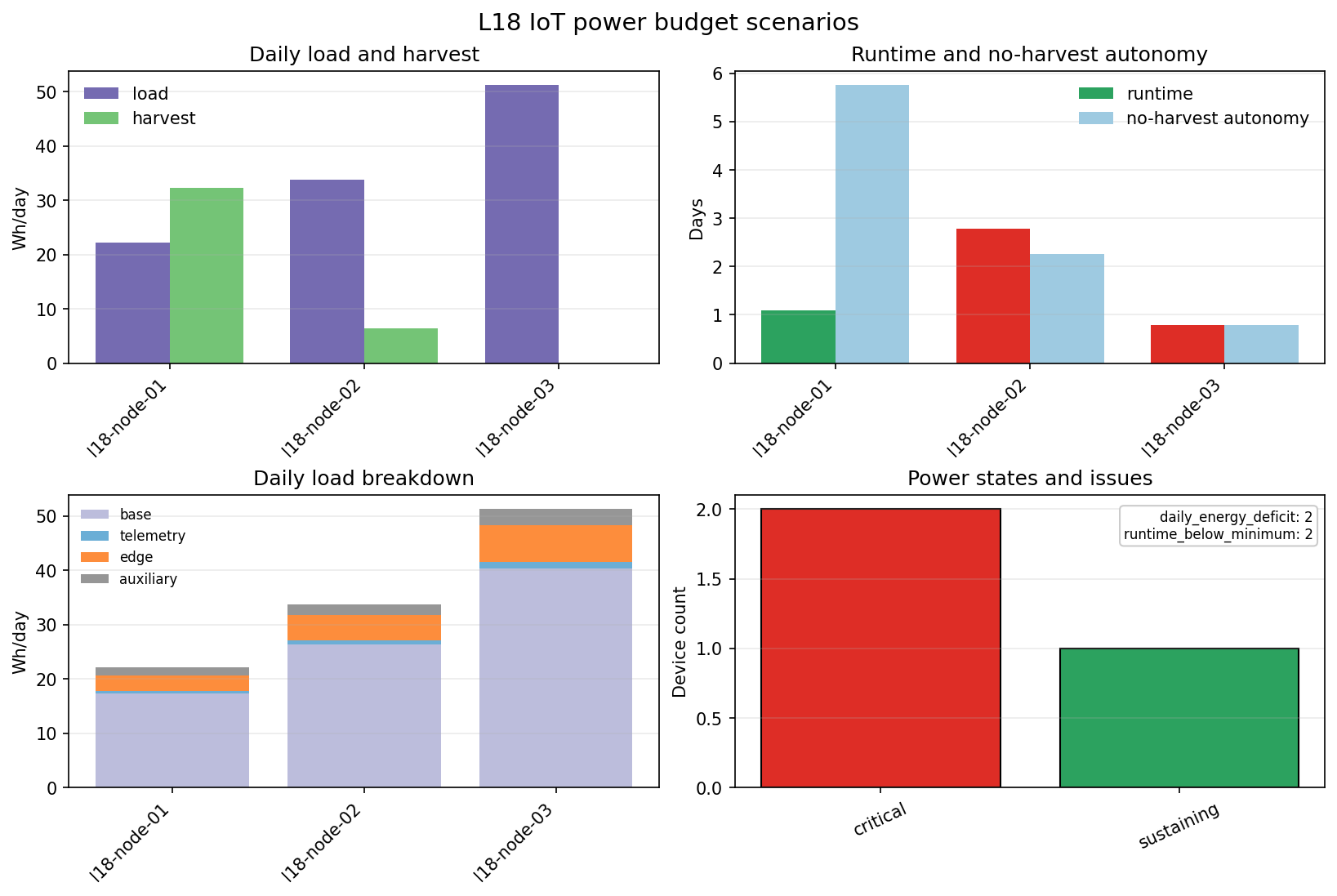
The top-left panel makes l18-node-01’s advantage visible at a glance:
its green harvest bar actually exceeds its purple load bar, the only
station where that happens, while l18-node-02’s harvest bar is a
small fraction of its load and l18-node-03 has no harvest bar at
all. The top-right panel is where the no-harvest-autonomy story from
above becomes shape rather than two similar-looking numbers in a table:
l18-node-01’s pale runtime bar towers over its own light-blue
autonomy bar, while for l18-node-02 the ordering flips — its runtime
edges out its autonomy — and for l18-node-03 the two bars are the
same height, exactly as expected with zero harvest. The load-breakdown
panel shows base recorder draw dominating every station’s bar, with
l18-node-03’s edge-processing slice (orange) visibly thicker than the
other two, consistent with its 0.80 edge duty cycle against 0.35-0.55
for the others. The states panel counts two critical devices and one
sustaining, with daily_energy_deficit and runtime_below_minimum
both firing exactly twice — once each for l18-node-02 and
l18-node-03, never for l18-node-01.
In field planning, revise the critical nodes before deployment: reduce duty cycle, shorten telemetry windows, add battery capacity, add solar harvesting, or lower auxiliary load. Record the final budget in the provenance manifest so runtime assumptions remain auditable alongside the rest of the deployment’s evidence.