Data corrections#
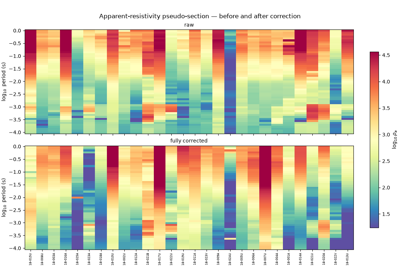
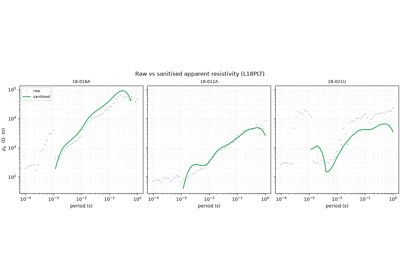
Correcting the impedance tensor — before inversion or interpretation — is one of pyCSAMT’s defining strengths. The package ships a catalogue of correction methods across six families; this section works through them as processing waves, each an example that takes the raw survey line to a cleaner one with publication-quality before/after figures.
The waves, applied to the bundled WILLY_DATA L18PLT line:
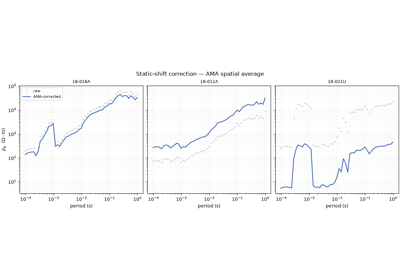
Static shift — remove the frequency-independent ρa offset with the AMA spatial average and the Hanning-EMAP filter;
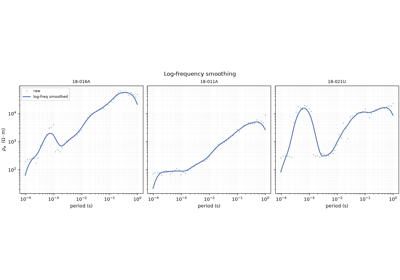
Noise removal — power-line notch, log-frequency smoothing, and robust ρ/φ trend smoothing;
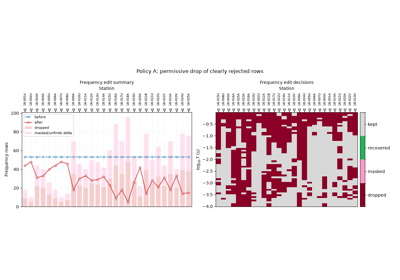
Confidence editing — keep, recover, mask, or drop station-frequency rows using auditable confidence thresholds;
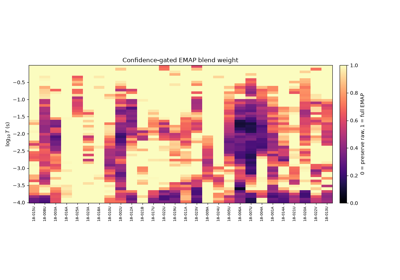
Confidence-gated EMAP — blend spatial filtering only where the confidence score says the data need help;
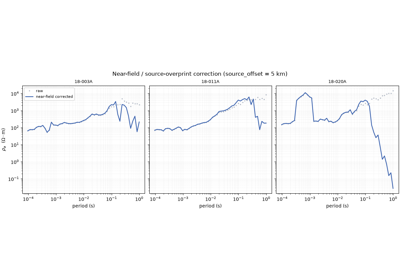
Source effects — detect and correct CSAMT near-field / source overprint;
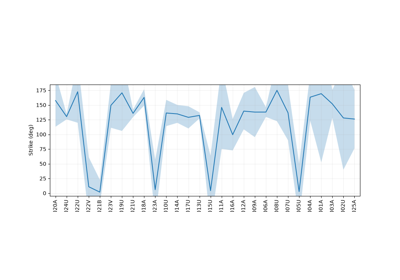
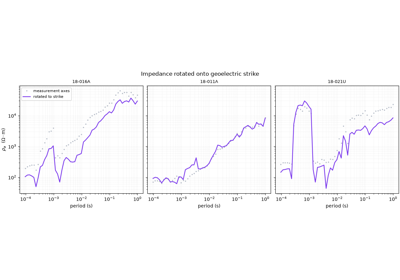
Tensor rotation — rotate onto geoelectric strike and antisymmetrise for 2-D inversion;
Galvanic distortion — estimate and audit a Groom–Bailey-style real distortion matrix before deciding whether to apply it;
A publication workflow — chain the corrections into one final, inversion-ready dataset;
A step-by-step walkthrough — take L18PLT and L22PLT from raw to sanitised EDIs, dropping bad frequencies and conditioning the survivors, with every step returning a new, cleaner dataset.
A pre-inversion case study — start from collected EDIs, make explicit processing decisions, correct the line, export corrected EDIs, and reload them as a final handoff check.
Every wave uses the real pycsamt.emtools correction functions — the same
ones the desktop and web apps expose on their Correction page — so the
scripts double as a recipe for scripting the corrections yourself. Further
waves (coordinate-geometry conditioning, Stratagem instrument chains) will
be added over time. See the emtools API reference.
Pre-inversion case study: from collected EDIs to corrected EDIs
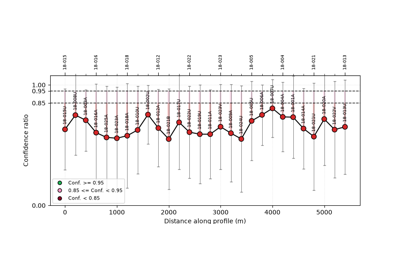
Reviewer-response audit for conditioned AMT/MT data
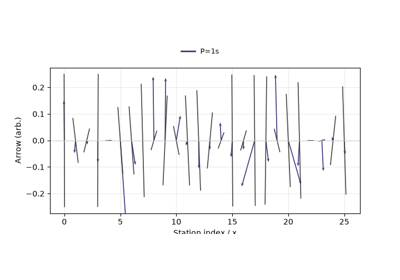
Processing a tipper survey (spectra to induction arrows)
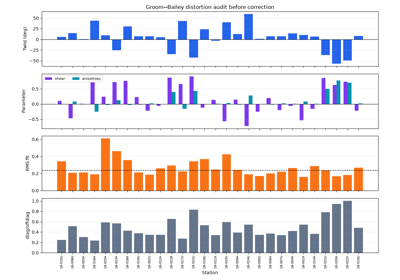
Galvanic-distortion case study with Groom–Bailey correction