
Note
Go to the end to download the full example code.
Prepare the final interpretation package#
The last step of an inversion workflow is not only making one attractive figure. A useful handoff package should let another geophysicist answer:
Which data and processing choices produced this model?
Which inversion run was selected, and why?
How well did the model fit the observations?
Which figures/tables support the interpretation?
What caveats should be carried into the report?
This example builds a report-ready interpretation package from the artefacts created by the previous inversion-gallery examples. It is intentionally solver-neutral in structure, but it also knows how to include the bundled ModEM result sample when available.
The package is written under docs/examples/inversion/workspaces so it can
be regenerated by the gallery without polluting the source tree.
1. Imports and package layout#
import json
import os
import shutil
import sys
from datetime import datetime, timezone
from pathlib import Path

# sphinx-gallery executes examples without __file__ (the gallery
# runner sets the working directory to this example's folder).
try:
    EXAMPLE_DIR = Path(__file__).resolve().parent
except NameError:
    EXAMPLE_DIR = Path.cwd()

import matplotlib.pyplot as plt
import numpy as np
import pandas as pd


def repo_root():
    root = os.environ.get("PYCSAMT_DOCS_REPO_ROOT")
    return Path(root) if root else EXAMPLE_DIR.parents[2]


ROOT = repo_root()
if str(ROOT) not in sys.path:
    sys.path.insert(0, str(ROOT))

from pycsamt.models.modem import InversionResult

example_dir = EXAMPLE_DIR
workspace = example_dir / "workspaces" / "l18_prepared_workspace"
modem_sample = ROOT / "data" / "modem" / "willy_27freq_watex_line02_sample"

source_table_dirs = [
    workspace / "02_tables",
    example_dir / "workspaces" / "modem_result_tables",
]
source_figure_dirs = [
    workspace / "05_figures",
    example_dir / "workspaces" / "modem_result_figures",
]

package_root = example_dir / "workspaces" / "final_interpretation_package"
package_dirs = {
    "figures": package_root / "figures",
    "tables": package_root / "tables",
    "models": package_root / "models",
    "logs": package_root / "logs",
    "metadata": package_root / "metadata",
    "report": package_root / "report",
}
for path in package_dirs.values():
    path.mkdir(parents=True, exist_ok=True)
2. Helper functions#
A final package should be deterministic. These helpers copy selected files, record their sizes, and write a manifest that can be reviewed later.
def copy_if_exists(src, dst_dir, label, required=False):
    src = Path(src)
    dst_dir = Path(dst_dir)
    record = {
        "label": label,
        "source": str(src),
        "destination": "",
        "exists": src.exists(),
        "required": bool(required),
        "size_bytes": 0,
    }
    if src.exists() and src.is_file():
        dst = dst_dir / src.name
        shutil.copy2(src, dst)
        record["destination"] = str(dst)
        record["size_bytes"] = dst.stat().st_size
    elif required:
        print(f"WARNING: required artefact missing: {src}")
    return record


def collect_by_suffix(src_dirs, suffixes, dst_dir, label, limit=None):
    records = []
    for src_dir in src_dirs:
        if not src_dir.exists():
            continue
        candidates = []
        for suffix in suffixes:
            candidates.extend(sorted(src_dir.glob(f"*{suffix}")))
        if limit is not None:
            candidates = candidates[:limit]
        for src in candidates:
            records.append(copy_if_exists(src, dst_dir, label))
    return records


def write_text(path, lines):
    path = Path(path)
    path.write_text("\n".join(lines) + "\n", encoding="utf-8")
    return path


def safe_float(value):
    try:
        value = float(value)
    except Exception:
        return None
    if not np.isfinite(value):
        return None
    return value
3. Collect preparation and validation artefacts#
These files document the input contract: station coverage, validation checks, data/error choices, model grid, and run-folder staging. If a report includes only the final model image but none of these files, it is hard to audit.
manifest_records = []

core_tables = [
    "inversion_input_validation_report.json",
    "inversion_input_validation_table.csv",
    "inversion_data_error_policy.json",
    "inversion_impedance_complex_table.csv",
    "inversion_rho_phase_table.csv",
    "starting_model_policy.json",
    "run_folder_audit.csv",
    "convergence_diagnostics.csv",
    "convergence_history_normalized.csv",
]

for name in core_tables:
    manifest_records.append(
        copy_if_exists(
            workspace / "02_tables" / name,
            package_dirs["tables"],
            label="workspace_table",
            required=False,
        )
    )
    manifest_records.append(
        copy_if_exists(
            workspace / "04_run_files" / name,
            package_dirs["tables"],
            label="run_file_table",
            required=False,
        )
    )

manifest_records.extend(
    collect_by_suffix(
        source_table_dirs,
        suffixes=(".csv", ".json"),
        dst_dir=package_dirs["tables"],
        label="analysis_table",
    )
)
4. Collect figures for interpretation#
The figure folder is deliberately broad: section plots, response diagnostics, scenario dashboards, convergence plots, and validation dashboards all belong in the final interpretation context. A report writer can then choose the best subset, but the package preserves the full audit trail.
manifest_records.extend(
    collect_by_suffix(
        source_figure_dirs,
        suffixes=(".png", ".jpg", ".jpeg", ".svg", ".pdf"),
        dst_dir=package_dirs["figures"],
        label="figure",
    )
)
5. Include compact ModEM result evidence#
The package should not duplicate a complete production inversion directory.
We include only small-to-moderate files that support interpretation:
convergence log, controls, README, and the final representative response/model
files already curated in data/modem.
modem_records = []
if modem_sample.exists():
    for name in [
        "README.txt",
        "Modular_NLCG.log",
        "inv.ctrl",
        "fwd.ctrl",
        "CSUr2.err",
        "Modular_NLCG_073.dat",
        "Modular_NLCG_073.res",
        "Modular_NLCG_073.rho",
    ]:
        modem_records.append(
            copy_if_exists(
                modem_sample / name,
                package_dirs["models"]
                if name.endswith(".rho")
                else package_dirs["logs"],
                label="modem_result_evidence",
                required=name in {"README.txt", "Modular_NLCG.log"},
            )
        )
manifest_records.extend(modem_records)
6. Summarize the selected ModEM run#
This section is intentionally compact. It records headline numbers that a reviewer can compare against response plots and section figures.
run_summary = {
    "available": False,
    "sample_dir": str(modem_sample),
}

if modem_sample.exists():
    result = InversionResult(
        modem_sample,
        load_control=False,
        load_covariance=False,
        load_models=False,
        load_data=False,
    )
    model_keys = [
        path.stem.replace("Modular_NLCG_", "iter_")
        for path in sorted(modem_sample.glob("Modular_NLCG_*.rho"))
        if path.stat().st_size > 0
    ]
    run_summary.update(
        {
            "available": True,
            "mode": result.mode,
            "n_log_records": int(result.n_iter),
            "final_rms": safe_float(result.final_rms),
            "best_rms": safe_float(result.best_rms),
            "iteration_numbers": [int(v) for v in result.iteration_numbers],
            "model_keys": model_keys,
            "has_observed_data": (
                modem_sample / "27-freq-run-watex01.dat"
            ).exists(),
            "has_predicted_data": (
                modem_sample / "Modular_NLCG_073.dat"
            ).exists(),
            "observed_sites": "not loaded in fast package mode",
            "observed_periods": "not loaded in fast package mode",
        }
    )

summary_file = package_dirs["metadata"] / "selected_inversion_run_summary.json"
summary_file.write_text(json.dumps(run_summary, indent=2), encoding="utf-8")
manifest_records.append(
    {
        "label": "run_summary",
        "source": "generated",
        "destination": str(summary_file),
        "exists": True,
        "required": True,
        "size_bytes": summary_file.stat().st_size,
    }
)
7. Create a report-ready figure index#
A package with 30 files is much easier to use when every figure has a short purpose. We infer a first-pass purpose from the filename. A human can edit this CSV before final report delivery.
def figure_purpose(name):
    lower = name.lower()
    if "validation" in lower:
        return "Input validation and data-readiness audit"
    if "convergence" in lower or "misfit" in lower:
        return "Inversion convergence / fit history"
    if "response" in lower or "pseudo" in lower or "residual" in lower:
        return "Observed-vs-predicted response diagnostic"
    if "section" in lower or "model" in lower:
        return "Model section or resistivity-structure diagnostic"
    if "scenario" in lower or "tradeoff" in lower:
        return "Scenario comparison and decision support"
    return "Supporting inversion figure"


figure_rows = []
for fig in sorted(package_dirs["figures"].glob("*")):
    if fig.is_file():
        figure_rows.append(
            {
                "file": fig.name,
                "purpose": figure_purpose(fig.name),
                "size_bytes": fig.stat().st_size,
                "include_in_report": "review",
            }
        )

figure_index = pd.DataFrame(figure_rows)
figure_index_file = package_dirs["metadata"] / "figure_index.csv"
figure_index.to_csv(figure_index_file, index=False)
8. Create an interpretation checklist#
This checklist is not just administrative. It prevents a common failure mode: exporting the final section without documenting why the model is defensible.
checklist = pd.DataFrame(
    [
        {
            "item": "Input validation has no blocking failures",
            "status": "review",
            "evidence": "inversion_input_validation_report.json",
        },
        {
            "item": "Error floors and masked data are documented",
            "status": "review",
            "evidence": "inversion_data_error_policy.json",
        },
        {
            "item": "Convergence history was inspected",
            "status": "review",
            "evidence": "convergence diagnostics / ModEM log",
        },
        {
            "item": "Observed vs predicted responses were compared",
            "status": "review",
            "evidence": "response panels, residual heatmaps, station summary",
        },
        {
            "item": "Scenario choice is justified beyond lowest RMS",
            "status": "review",
            "evidence": "inversion_scenario_recommendation.json",
        },
        {
            "item": "Final section caveats are written in the report memo",
            "status": "review",
            "evidence": "interpretation_memo.md",
        },
    ]
)
checklist_file = package_dirs["metadata"] / "interpretation_checklist.csv"
checklist.to_csv(checklist_file, index=False)
9. Write the interpretation memo#
The memo is a report skeleton. It is intentionally conservative: it records what was packaged, what remains to review, and which caveats should be carried forward. Users can edit it into a project-specific report section.
created_utc = datetime.now(timezone.utc).strftime("%Y-%m-%d %H:%M:%S UTC")
memo_lines = [
    "# Final inversion interpretation package",
    "",
    f"Created: {created_utc}",
    "",
    "## Purpose",
    "",
    "This package collects inversion-preparation tables, validation outputs, "
    "convergence diagnostics, response checks, scenario-comparison artefacts, "
    "and selected ModEM result evidence for report preparation.",
    "",
    "## Selected inversion run",
    "",
]

if run_summary["available"]:
    memo_lines.extend(
        [
            f"- Source folder: `{run_summary['sample_dir']}`",
            f"- Detected mode: `{run_summary['mode']}`",
            f"- Parsed log records: `{run_summary['n_log_records']}`",
            f"- Final RMS: `{run_summary['final_rms']}`",
            f"- Best RMS: `{run_summary['best_rms']}`",
            f"- Model snapshots: `{', '.join(run_summary['model_keys'])}`",
            f"- Observed sites: `{run_summary['observed_sites']}`",
            f"- Observed periods: `{run_summary['observed_periods']}`",
        ]
    )
else:
    memo_lines.append("- No bundled ModEM result sample was available.")

memo_lines.extend(
    [
        "",
        "## Recommended review order",
        "",
        "1. Read `metadata/interpretation_checklist.csv`.",
        "2. Inspect input validation and data/error policy tables.",
        "3. Inspect convergence and scenario-comparison figures.",
        "4. Inspect observed-vs-predicted response figures and residual tables.",
        "5. Only then select final model-section figures for the report.",
        "",
        "## Caveats to carry into interpretation",
        "",
        "- A low RMS does not guarantee a geologically meaningful model.",
        "- Coherent response residuals should be explained before interpreting "
        "nearby model features.",
        "- Structures that appear only in late iterations or aggressive-error "
        "scenarios require extra caution.",
        "- Topography, static shift, and error floors should be described in "
        "the final report.",
        "- This gallery package is a reproducible template; project teams should "
        "replace demonstration scenario rows with their real run folders.",
        "",
        "## Package contents",
        "",
        "- `figures/`: copied diagnostic and interpretation figures.",
        "- `tables/`: copied CSV/JSON data, validation, response, and scenario tables.",
        "- `models/`: selected representative model artefacts.",
        "- `logs/`: solver logs, control files, and run notes.",
        "- `metadata/`: manifests, figure index, checklist, and run summary.",
    ]
)

memo_file = write_text(
    package_dirs["report"] / "interpretation_memo.md", memo_lines
)
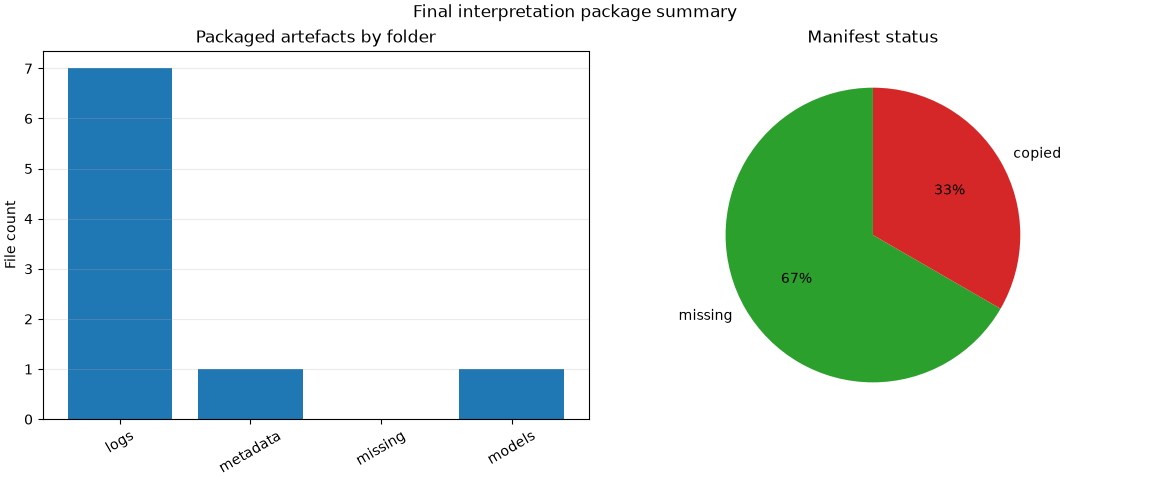
10. Write the package manifest and a package summary figure#
manifest = pd.DataFrame(manifest_records)
manifest = manifest.drop_duplicates(subset=["destination", "source", "label"])
manifest_file = package_dirs["metadata"] / "package_manifest.csv"
manifest.to_csv(manifest_file, index=False)

summary_counts = (
    manifest.assign(
        category=manifest["destination"].map(
            lambda p: (
                Path(p).parent.name if isinstance(p, str) and p else "missing"
            )
        )
    )
    .groupby("category")
    .agg(n_files=("destination", lambda s: int(np.sum([bool(v) for v in s]))))
    .reset_index()
)

fig, axes = plt.subplots(1, 2, figsize=(11.5, 4.8), constrained_layout=True)
ax_count, ax_status = axes

ax_count.bar(
    summary_counts["category"], summary_counts["n_files"], color="tab:blue"
)
ax_count.set_title("Packaged artefacts by folder")
ax_count.set_ylabel("File count")
ax_count.tick_params(axis="x", rotation=30)
ax_count.grid(axis="y", alpha=0.25)

status_counts = (
    manifest["exists"]
    .value_counts()
    .rename(index={True: "copied", False: "missing"})
)
ax_status.pie(
    status_counts.to_numpy(),
    labels=status_counts.index,
    autopct="%1.0f%%",
    startangle=90,
    colors=["tab:green", "tab:red"][: len(status_counts)],
)
ax_status.set_title("Manifest status")

fig.suptitle("Final interpretation package summary")
summary_plot = package_dirs["metadata"] / "package_summary.png"
fig.savefig(summary_plot, dpi=120)
plt.show()

print(f"Package root: {package_root}")
print(f"Manifest: {manifest_file}")
print(f"Figure index: {figure_index_file}")
print(f"Checklist: {checklist_file}")
print(f"Run summary: {summary_file}")
print(f"Interpretation memo: {memo_file}")
print(f"Package summary figure: {summary_plot}")
Package root: /opt/build/repo/docs/examples/inversion/workspaces/final_interpretation_package
Manifest: /opt/build/repo/docs/examples/inversion/workspaces/final_interpretation_package/metadata/package_manifest.csv
Figure index: /opt/build/repo/docs/examples/inversion/workspaces/final_interpretation_package/metadata/figure_index.csv
Checklist: /opt/build/repo/docs/examples/inversion/workspaces/final_interpretation_package/metadata/interpretation_checklist.csv
Run summary: /opt/build/repo/docs/examples/inversion/workspaces/final_interpretation_package/metadata/selected_inversion_run_summary.json
Interpretation memo: /opt/build/repo/docs/examples/inversion/workspaces/final_interpretation_package/report/interpretation_memo.md
Package summary figure: /opt/build/repo/docs/examples/inversion/workspaces/final_interpretation_package/metadata/package_summary.png
11. What to deliver#
For a real project handoff, zip or archive final_interpretation_package
after reviewing the checklist. The recommended minimum deliverables are:
one final model-section figure plus one scenario-comparison figure;
observed-vs-predicted response panels for representative stations;
residual heatmap or station/component misfit table;
convergence log/plot;
data/error policy and validation report;
a short memo explaining caveats and why the selected scenario is preferred.
This structure helps future users reproduce the interpretation path instead of only seeing the final picture.
Total running time of the script: (0 minutes 0.222 seconds)