
Note
Go to the end to download the full example code.
Create ModEM/Occam-style run folders#
At this point the inversion workspace contains corrected EDIs, data/error tables, a starting model grid, and a validation report. The next practical step is to assemble run folders for one or more inversion backends.
This example creates two backend-style folders:
modem_2d— a ModEM-style folder with impedance data, model arrays, a realModEM.invcontrol file, and launch notes;occam2d— an Occam2D-style folder with rho/phase data, mesh/model arrays, startup/config notes, and launch notes.
The example does not launch ModEM or Occam. Documentation builds should not require external Fortran executables. Instead, it prepares an auditable folder that a user can inspect, adapt, version-control, and run manually.
1. Imports and workspace paths#
import csv
import json
import os
import shutil
import sys
from dataclasses import asdict
from pathlib import Path

# sphinx-gallery executes examples without __file__ (the gallery
# runner sets the working directory to this example's folder).
try:
    EXAMPLE_DIR = Path(__file__).resolve().parent
except NameError:
    EXAMPLE_DIR = Path.cwd()

import matplotlib.pyplot as plt
import pandas as pd


def repo_root():
    root = os.environ.get("PYCSAMT_DOCS_REPO_ROOT")
    return Path(root) if root else EXAMPLE_DIR.parents[2]


ROOT = repo_root()
if str(ROOT) not in sys.path:
    sys.path.insert(0, str(ROOT))

from pycsamt.models.modem import ModEmConfig, ModEmControl
from pycsamt.models.occam2d import OccamConfig

workspace = EXAMPLE_DIR / "workspaces" / "l18_prepared_workspace"
table_dir = workspace / "02_tables"
model_dir = workspace / "03_model_placeholder"
run_root = workspace / "04_run_files"
figure_dir = workspace / "05_figures"

modem_dir = run_root / "modem_2d"
occam_dir = run_root / "occam2d"

for path in (modem_dir, occam_dir, figure_dir):
    path.mkdir(parents=True, exist_ok=True)
2. Load validated workspace artefacts#
A run folder should be built from validated artefacts, not directly from raw field data. If the validation report contains FAIL rows, stop here.
validation_report = table_dir / "inversion_input_validation_report.json"
if not validation_report.exists():
    raise RuntimeError(
        "Validation report missing. Run plot_4_validate_inversion_inputs.py first."
    )

report = json.loads(validation_report.read_text(encoding="utf-8"))
status_counts = report["status_counts"]
print("Validation status counts:")
print(json.dumps(status_counts, indent=2))

if status_counts.get("FAIL", 0):
    raise RuntimeError(
        "Workspace validation has FAIL rows; do not create run folders."
    )

complex_table = table_dir / "inversion_impedance_complex_table.csv"
rho_phase_table = table_dir / "inversion_rho_phase_table.csv"
data_policy_file = table_dir / "inversion_data_error_policy.json"
model_policy_file = model_dir / "starting_model_policy.json"

complex_df = pd.read_csv(complex_table)
rho_phase_df = pd.read_csv(rho_phase_table)
data_policy = json.loads(data_policy_file.read_text(encoding="utf-8"))
model_policy = json.loads(model_policy_file.read_text(encoding="utf-8"))

print(f"Complex impedance rows: {len(complex_df)}")
print(f"Rho/phase rows: {len(rho_phase_df)}")
Validation status counts:
{
  "PASS": 29,
  "WARN": 1,
  "FAIL": 0
}
Complex impedance rows: 2184
Rho/phase rows: 2184
3. Common helpers#
def copy_required(src, dst):
    src = Path(src)
    dst = Path(dst)
    dst.parent.mkdir(parents=True, exist_ok=True)
    shutil.copy2(src, dst)
    return dst


def write_text(path, text):
    path = Path(path)
    path.parent.mkdir(parents=True, exist_ok=True)
    path.write_text(text, encoding="utf-8")
    return path


def write_csv(path, rows):
    rows = list(rows)
    if not rows:
        return
    keys = []
    for row in rows:
        for key in row:
            if key not in keys:
                keys.append(key)
    with Path(path).open("w", newline="", encoding="utf-8") as f:
        writer = csv.DictWriter(f, fieldnames=keys)
        writer.writeheader()
        writer.writerows(rows)


def json_default(obj):
    if isinstance(obj, Path):
        return str(obj)
    return str(obj)
4. Build a ModEM-style 2-D run folder#
ModEmControl writes a real ModEM .inv key-value control file. The
data and model files here are still lightweight CSV/JSON artefacts; a later
backend writer can convert them to exact ModEM ASCII syntax.
modem_config = ModEmConfig(
    mode="2d",
    component_type="Off_Diagonal_Impedance",
    error_floor_z=data_policy["impedance_error"]["relative_z"],
    error_floor_z_floor=data_policy["impedance_error"]["absolute_z"],
    freq_min=data_policy["frequency_band_hz"]["fmin"],
    freq_max=data_policy["frequency_band_hz"]["fmax"],
    nx_2d=model_policy["horizontal"]["n_cells"],
    nz_2d=model_policy["vertical"]["n_layers"],
    cell_size_h_2d=model_policy["horizontal"]["inner_dx_m"],
    cell_size_v_top_2d=model_policy["vertical"]["first_dz_m"],
    depth_scale_2d=model_policy["vertical"]["growth"],
    n_padding_x_2d=model_policy["horizontal"]["padding_cells_each_side"],
    initial_rho=model_policy["resistivity"]["background_ohmm"],
    target_rms=1.05,
    max_iterations=80,
    output_stem="L18_modem2d",
)

modem_control = ModEmControl.from_config(modem_config)
modem_control_path = modem_control.write(modem_dir / modem_config.control_file)

modem_data = modem_dir / modem_config.data_file
modem_model = modem_dir / modem_config.model_file
modem_x_edges = modem_dir / "x_edges_m.csv"
modem_z_edges = modem_dir / "z_edges_m.csv"

copy_required(table_dir / "backend_modem_style_impedance_long.csv", modem_data)
copy_required(model_dir / "starting_resistivity_ohmm.csv", modem_model)
copy_required(model_dir / "x_edges_m.csv", modem_x_edges)
copy_required(model_dir / "z_edges_m.csv", modem_z_edges)
copy_required(validation_report, modem_dir / "validation_report.json")

modem_manifest = {
    "backend": "ModEM-style",
    "dimensionality": "2D",
    "status": "prepared_not_launched",
    "control_file": modem_config.control_file,
    "data_file": modem_config.data_file,
    "model_file": modem_config.model_file,
    "validation_report": "validation_report.json",
    "config": asdict(modem_config),
    "notes": [
        "Data file is a pyCSAMT long-table staging file, not final ModEM ASCII syntax.",
        "Use a backend writer or project adapter to convert before running ModEM.",
        "The ModEM.inv file is a real key-value control file created by ModEmControl.",
    ],
}

write_text(
    modem_dir / "run_manifest.json",
    json.dumps(modem_manifest, indent=2, default=json_default),
)

modem_command = (
    f"{modem_config.binary_name} {modem_config.control_file} "
    f"{modem_config.model_file} {modem_config.data_file}"
)

write_text(
    modem_dir / "RUN_NOTES.md",
    "\n".join(
        [
            "# ModEM-style run folder",
            "",
            "This folder is prepared but not launched.",
            "",
            "## Candidate command",
            "",
            "```bash",
            modem_command,
            "```",
            "",
            "Before running, convert the staging CSV data/model files to the exact",
            "ModEM ASCII format required by your executable and confirm impedance",
            "units/sign convention.",
            "",
        ]
    ),
)

print("ModEM-style run folder:", modem_dir)
print("ModEM control file:", modem_control_path)
ModEM-style run folder: /opt/build/repo/docs/examples/inversion/workspaces/l18_prepared_workspace/04_run_files/modem_2d
ModEM control file: /opt/build/repo/docs/examples/inversion/workspaces/l18_prepared_workspace/04_run_files/modem_2d/ModEM.inv
5. Build an Occam2D-style run folder#
Occam2D commonly works with apparent resistivity and phase rows. We use the rho/phase long table and write a documented configuration snapshot.
occam_config = OccamConfig(
    modes=["TE", "TM"],
    error_floor_rho=data_policy["derived_error"]["logrho_min"],
    error_floor_phase=data_policy["derived_error"]["phase_min_deg"],
    freq_min=data_policy["frequency_band_hz"]["fmin"],
    freq_max=data_policy["frequency_band_hz"]["fmax"],
    n_layers=model_policy["vertical"]["n_layers"],
    cell_size_horizontal=model_policy["horizontal"]["inner_dx_m"],
    cell_size_vertical_top=model_policy["vertical"]["first_dz_m"],
    depth_scale=model_policy["vertical"]["growth"],
    n_padding_x=model_policy["horizontal"]["padding_cells_each_side"],
    initial_rho=model_policy["resistivity"]["background_ohmm"],
    max_iterations=80,
    target_misfit=1.0,
)

copy_required(
    table_dir / "backend_occam_style_rho_phase_long.csv",
    occam_dir / occam_config.data_file,
)
copy_required(model_dir / "x_edges_m.csv", occam_dir / occam_config.mesh_file)
copy_required(
    model_dir / "starting_log10_resistivity.csv",
    occam_dir / occam_config.model_file,
)
copy_required(model_dir / "z_edges_m.csv", occam_dir / "z_edges_m.csv")
copy_required(validation_report, occam_dir / "validation_report.json")

occam_startup_text = "\n".join(
    [
        "# Occam2D-style startup staging file",
        "# This is a readable pyCSAMT staging file, not final Fortran syntax.",
        f"data_file: {occam_config.data_file}",
        f"mesh_file: {occam_config.mesh_file}",
        f"model_file: {occam_config.model_file}",
        f"target_misfit: {occam_config.target_misfit}",
        f"max_iterations: {occam_config.max_iterations}",
        f"initial_rho: {occam_config.initial_rho}",
        f"lagrange_start: {occam_config.lagrange_start}",
        f"roughness_type: {occam_config.roughness_type}",
    ]
)
write_text(occam_dir / occam_config.startup_file, occam_startup_text)

occam_manifest = {
    "backend": "Occam2D-style",
    "status": "prepared_not_launched",
    "data_file": occam_config.data_file,
    "mesh_file": occam_config.mesh_file,
    "model_file": occam_config.model_file,
    "startup_file": occam_config.startup_file,
    "validation_report": "validation_report.json",
    "config": asdict(occam_config),
    "notes": [
        "Data file is a pyCSAMT rho/phase long-table staging file.",
        "Mesh/model/startup files are readable staging files.",
        "Use Occam2D InputBuilder or a project adapter for exact Occam2D syntax.",
    ],
}

write_text(
    occam_dir / "run_manifest.json",
    json.dumps(occam_manifest, indent=2, default=json_default),
)

occam_command = f"{occam_config.binary_name} {occam_config.startup_file}"
write_text(
    occam_dir / "RUN_NOTES.md",
    "\n".join(
        [
            "# Occam2D-style run folder",
            "",
            "This folder is prepared but not launched.",
            "",
            "## Candidate command",
            "",
            "```bash",
            occam_command,
            "```",
            "",
            "Before running, convert the staging files to exact Occam2D input",
            "syntax or rebuild them with `pycsamt.models.occam2d.InputBuilder`.",
            "",
        ]
    ),
)

print("Occam2D-style run folder:", occam_dir)
Occam2D-style run folder: /opt/build/repo/docs/examples/inversion/workspaces/l18_prepared_workspace/04_run_files/occam2d
6. Run-folder audit#
Check that each folder contains the files a user expects before handing it to a solver-specific conversion or launch step.
expected = {
    "modem_2d": [
        modem_config.control_file,
        modem_config.data_file,
        modem_config.model_file,
        "x_edges_m.csv",
        "z_edges_m.csv",
        "validation_report.json",
        "run_manifest.json",
        "RUN_NOTES.md",
    ],
    "occam2d": [
        occam_config.data_file,
        occam_config.mesh_file,
        occam_config.model_file,
        occam_config.startup_file,
        "z_edges_m.csv",
        "validation_report.json",
        "run_manifest.json",
        "RUN_NOTES.md",
    ],
}

audit_rows = []
for folder_name, files in expected.items():
    folder = run_root / folder_name
    for filename in files:
        path = folder / filename
        audit_rows.append(
            {
                "folder": folder_name,
                "file": filename,
                "exists": path.exists(),
                "size_bytes": path.stat().st_size if path.exists() else 0,
            }
        )

audit_path = run_root / "run_folder_audit.csv"
write_csv(audit_path, audit_rows)

audit_df = pd.DataFrame(audit_rows)
print("Run-folder audit:")
print(audit_df.to_string(index=False))

if not audit_df["exists"].all():
    raise RuntimeError("One or more expected run-folder files are missing.")
Run-folder audit:
  folder                   file  exists  size_bytes
modem_2d              ModEM.inv    True         381
modem_2d          ModEMData.dat    True      173870
modem_2d        ModEM_Model.rho    True       52800
modem_2d          x_edges_m.csv    True        1312
modem_2d          z_edges_m.csv    True         635
modem_2d validation_report.json    True        5833
modem_2d      run_manifest.json    True        1982
modem_2d           RUN_NOTES.md    True         314
 occam2d      OccamDataFile.dat    True      333172
 occam2d            Occam2DMesh    True        1312
 occam2d           Occam2DModel    True       52800
 occam2d                Startup    True         289
 occam2d          z_edges_m.csv    True         635
 occam2d validation_report.json    True        5833
 occam2d      run_manifest.json    True        1232
 occam2d           RUN_NOTES.md    True         254
7. Visual summary#
fig, axs = plt.subplots(1, 2, figsize=(11.0, 4.2))

row_counts = [
    len(pd.read_csv(modem_dir / modem_config.data_file)),
    len(pd.read_csv(occam_dir / occam_config.data_file)),
]
axs[0].bar(
    ["ModEM-style", "Occam2D-style"], row_counts, color=["#2563eb", "#16a34a"]
)
axs[0].set_ylabel("Data rows")
axs[0].set_title("Rows staged for each backend")
axs[0].grid(axis="y", alpha=0.25)

status = audit_df.groupby("folder")["exists"].mean()
axs[1].bar(status.index, status.values, color="#7c3aed")
axs[1].set_ylim(0, 1.05)
axs[1].set_ylabel("Completeness fraction")
axs[1].set_title("Run-folder completeness")
axs[1].grid(axis="y", alpha=0.25)

fig.tight_layout()
fig.savefig(figure_dir / "run_folder_creation_summary.png", dpi=160)
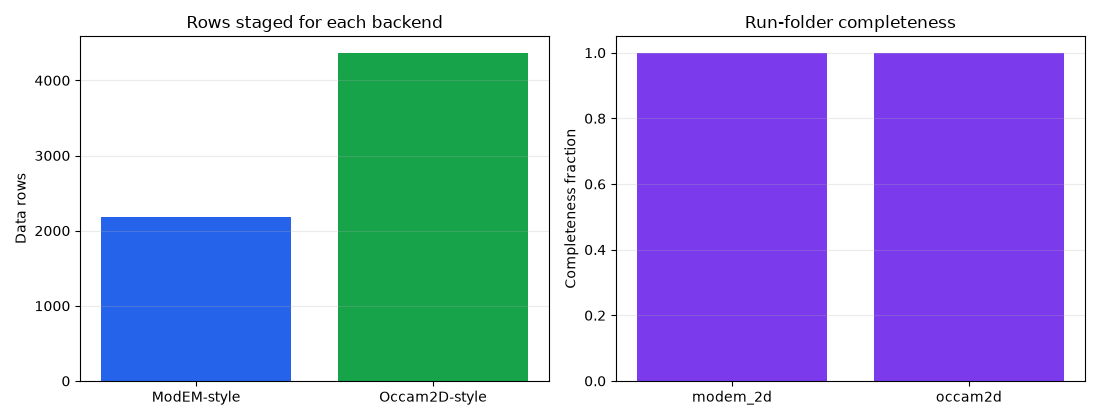
8. What is safe to do next?#
These folders are now organized, documented, and validated. The next step is backend-specific conversion:
for ModEM, convert the impedance long table and model grid to exact ModEM ASCII data/model/covariance syntax, then run the command in
RUN_NOTES;for Occam2D, either convert the staged rho/phase table to
OccamDataFilesyntax or rebuild from EDIs usingpycsamt.models.occam2d.InputBuilder;after a solver run, parse the log and plot RMS convergence before interpreting the final resistivity section.
Total running time of the script: (0 minutes 0.223 seconds)