
Note
Go to the end to download the full example code.
Config-driven pipelines and reproducibility#
The strongest reproducibility guarantee is a pipeline you can serialise to a
file and rebuild byte-for-byte later. Pipeline
round-trips to YAML/JSON/Python, and every run also drops a
pipeline.yaml beside its outputs — so any result can be traced back to
the exact recipe that made it.
A pipeline serialises to YAML#
Pipeline.to_yaml_string() writes the whole definition — step order,
codes, and every parameter — as human-readable YAML. This is the artefact
you commit to version control.
from pycsamt.pipeline import Pipeline, Step

pipe = Pipeline(
    [
        ("select_band", Step("FREQ001", band_hz=(0.01, 10_000))),
        ("notch", Step("NR001", mains_hz=50)),
        ("static_shift", Step("SS001")),
        ("qc_snap", Step("QC001")),
    ],
    name="documented_workflow",
)
yaml_text = pipe.to_yaml_string()
print(yaml_text)
name: documented_workflow
steps:
- name: select_band
  code: FREQ001
  params:
    band_hz:
    - 0.01
    - 10000
- name: notch
  code: NR001
  params:
    mains_hz: 50
    n_harm: 30
    tol_hz: 0.08
- name: static_shift
  code: SS001
- name: qc_snap
  code: QC001
… and rebuilds exactly#
Pipeline.from_yaml() reconstructs the pipeline from that file. The
reloaded object has the identical step sequence and parameters — the basis
for “run the same processing on next year’s survey”.
from _pipe_data import scratch_dir

cfg_path = scratch_dir() / "workflow.yaml"
pipe.to_yaml(cfg_path)
reloaded = Pipeline.from_yaml(cfg_path)

original = [(lbl, s.spec.code) for lbl, s in pipe]
restored = [(lbl, s.spec.code) for lbl, s in reloaded]
print("round-trip identical:", original == restored)
for lbl, code in restored:
    print(f"  {lbl:<14} {code}")
round-trip identical: True
  select_band    FREQ001
  notch          NR001
  static_shift   SS001
  qc_snap        QC001
Config files can also compose a preset#
A YAML config may name a preset and then append extra steps, so you
can start from a curated workflow and add project-specific tweaks — all
captured in one file. The config format is:
Pipeline.from_yaml(), from_json(),
and from_py() all read this shape.
The workflow, drawn from the config#
A tiny diagram of the reloaded pipeline makes the recipe legible at a glance — the sequence of steps the config encodes.
import matplotlib.pyplot as plt
from matplotlib.patches import FancyArrowPatch, FancyBboxPatch

fig, ax = plt.subplots(figsize=(10, 2.4), constrained_layout=True)
ax.set_axis_off()
ax.set_xlim(0, 1)
ax.set_ylim(0, 1)
n = len(restored)
xs = [(i + 0.5) / n for i in range(n)]
for i, (lbl, code) in enumerate(restored):
    ax.add_patch(
        FancyBboxPatch(
            (xs[i] - 0.4 / n, 0.35),
            0.8 / n,
            0.34,
            boxstyle="round,pad=0.01,rounding_size=0.02",
            fc="#eef3fb",
            ec="#3e65b0",
            lw=1.4,
        )
    )
    ax.text(
        xs[i], 0.57, code, ha="center", va="center", fontsize=9, weight="bold"
    )
    ax.text(
        xs[i],
        0.45,
        lbl,
        ha="center",
        va="center",
        fontsize=7.5,
        color="#374151",
    )
    if i < n - 1:
        ax.add_patch(
            FancyArrowPatch(
                (xs[i] + 0.42 / n, 0.52),
                (xs[i + 1] - 0.42 / n, 0.52),
                arrowstyle="-|>",
                mutation_scale=13,
                color="#64748b",
                lw=1.3,
            )
        )
ax.set_title(
    f"pipeline '{reloaded.name}' — rebuilt from workflow.yaml", fontsize=10
)
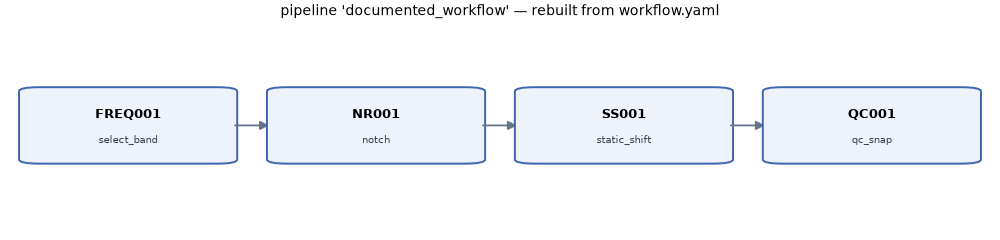
Text(0.5, 1.0, "pipeline 'documented_workflow' — rebuilt from workflow.yaml")
Takeaway. Because the pipeline is the config, a result and its recipe
never drift apart: commit the pipeline.yaml, and the run is
reproducible anywhere. This is what makes preset-plus-tweaks workflows
auditable across a project and over time.
Total running time of the script: (0 minutes 0.057 seconds)