
Note
Go to the end to download the full example code.
Prepare an inversion workspace from corrected EDIs#
After correction, the next practical task is not usually “run inversion” immediately. A careful interpreter first creates an inversion workspace: a folder that contains the corrected EDIs, station metadata, selected frequency band, data/error tables, notes, and a machine-readable processing policy.
This example shows that preparation step in a solver-neutral way. The output can later be adapted to ModEM, Occam2D, MARE2DEM, a custom 1-D inversion, or any internal workflow.
The example uses the bundled WILLY L18PLT line so it can run during the
documentation build. In a real project, replace corrected_edi_dir with
the folder produced by your correction workflow, for example the exported
folder from the pre-inversion correction case study.
1. Imports and project paths#
Keep imports at the top so users can copy this page into a processing notebook or a field-project script.
import csv
import json
import os
import sys
from datetime import datetime, timezone
from pathlib import Path

# sphinx-gallery executes examples without __file__ (the gallery
# runner sets the working directory to this example's folder).
try:
    EXAMPLE_DIR = Path(__file__).resolve().parent
except NameError:
    EXAMPLE_DIR = Path.cwd()

import matplotlib.pyplot as plt
import numpy as np


def repo_root():
    root = os.environ.get("PYCSAMT_DOCS_REPO_ROOT")
    return Path(root) if root else EXAMPLE_DIR.parents[2]


ROOT = repo_root()
if str(ROOT) not in sys.path:
    sys.path.insert(0, str(ROOT))

from pycsamt.emtools import drop_duplicates, ensure_sites, select_band
from pycsamt.emtools._core import _get_z_block, _iter_items, _name
from pycsamt.site import SitesReport, write_sites

# Replace this path with your corrected EDI folder.
corrected_edi_dir = ROOT / "data" / "AMT" / "WILLY_DATA" / "L18PLT"

# The workspace is deliberately inside the example folder for this gallery.
# In a real project this would be something like:
# ``PROJECT_ROOT / "inversion" / "L18_2026_07_prepared"``.
workspace = EXAMPLE_DIR / "workspaces" / "l18_prepared_workspace"
2. Decide the inversion contract before writing files#
A workspace is valuable because it records decisions. These choices should be made explicitly, before exporting any inversion files:
What is the input data source?
Which frequency band is trusted?
Which tensor components will be inverted?
What error floor will be used when the EDI error is missing or too small?
Is topography included now, or only later during model/mesh preparation?
policy = {
    "project": "WILLY L18 demonstration",
    "line": "L18PLT",
    "source_type": "corrected_edi_folder",
    "source_path": str(corrected_edi_dir),
    "frequency_band_hz": {
        "fmin": 1e-3,
        "fmax": 1e3,
    },
    "components": ["xy", "yx"],
    "error_floor": {
        "relative_z": 0.05,
        "absolute_z": 1e-12,
        "comment": "Use max(EDI error, relative_z * |Z|, absolute_z).",
    },
    "topography": {
        "include_station_elevation": True,
        "mesh_topography": "defer_to_next_example",
    },
    "target_backend": "solver_neutral",
    "created_utc": datetime.now(timezone.utc).isoformat(),
}

print("Workspace policy:")
print(json.dumps(policy, indent=2))
Workspace policy:
{
  "project": "WILLY L18 demonstration",
  "line": "L18PLT",
  "source_type": "corrected_edi_folder",
  "source_path": "/opt/build/repo/data/AMT/WILLY_DATA/L18PLT",
  "frequency_band_hz": {
    "fmin": 0.001,
    "fmax": 1000.0
  },
  "components": [
    "xy",
    "yx"
  ],
  "error_floor": {
    "relative_z": 0.05,
    "absolute_z": 1e-12,
    "comment": "Use max(EDI error, relative_z * |Z|, absolute_z)."
  },
  "topography": {
    "include_station_elevation": true,
    "mesh_topography": "defer_to_next_example"
  },
  "target_backend": "solver_neutral",
  "created_utc": "2026-10-02T15:13:19.509631+00:00"
}
3. Load and audit the corrected EDIs#
The loader should find one impedance-bearing station per EDI. If this audit fails, do not build inversion files yet; go back to correction/export.
sites = ensure_sites(corrected_edi_dir, recursive=False, verbose=0)
summary = SitesReport(sites).to_dataframe(api=False)

print(f"Stations loaded: {len(summary)}")
print(
    "Frequency rows per station: "
    f"{summary['nfreq'].min()}-{summary['nfreq'].max()}"
)
print("Station summary:")
print(
    summary[["station", "nfreq", "lat", "lon", "elev"]]
    .head(8)
    .to_string(index=False)
)

if summary.empty:
    raise RuntimeError(
        "No stations were loaded from the corrected EDI folder."
    )
if summary["nfreq"].min() <= 0:
    raise RuntimeError("At least one station has no valid frequency rows.")
Stations loaded: 28
Frequency rows per station: 53-53
Station summary:
station  nfreq       lat        lon  elev
18-001A     53 32.120300 119.128833  99.0
18-002U     53 32.121133 119.128900 110.0
18-003A     53 32.122083 119.128850  81.0
18-004A     53 32.123333 119.128833  99.0
18-005U     53 32.123900 119.128833 115.0
18-006A     53 32.124767 119.128783 124.0
18-007U     53 32.125717 119.128817 126.0
18-008U     53 32.126617 119.128800 106.0
4. Normalize the frequency band#
Frequency preparation for inversion is usually more conservative than for a quick plot. We remove duplicates and select the intended band. This step does not decide error floors or mesh design; it only makes the input line consistent enough for the workspace.
prepared = drop_duplicates(sites, recursive=False)
prepared = select_band(
    prepared,
    fmin=policy["frequency_band_hz"]["fmin"],
    fmax=policy["frequency_band_hz"]["fmax"],
    recursive=False,
)
prepared_summary = SitesReport(prepared).to_dataframe(api=False)

print(
    "Prepared frequency rows per station: "
    f"{prepared_summary['nfreq'].min()}-{prepared_summary['nfreq'].max()}"
)
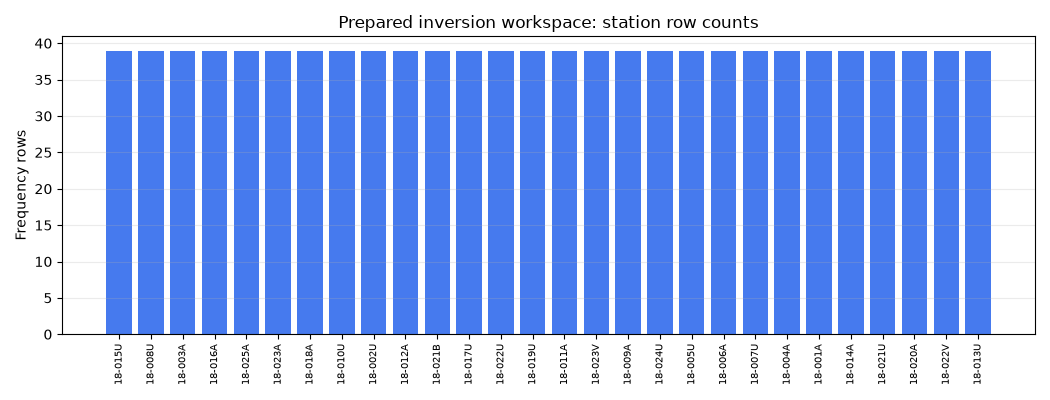
Prepared frequency rows per station: 39-39
5. Create the workspace layout#
A predictable layout makes handoff easier. The external solver may require different filenames later, but these folders keep the preparation artefacts organized.
folders = {
    "root": workspace,
    "edi": workspace / "01_corrected_edis",
    "tables": workspace / "02_tables",
    "model": workspace / "03_model_placeholder",
    "run": workspace / "04_run_files",
    "figures": workspace / "05_figures",
    "notes": workspace / "06_notes",
}

for path in folders.values():
    path.mkdir(parents=True, exist_ok=True)

print("Workspace folders:")
for key, path in folders.items():
    print(f"  {key:>7}: {path}")
Workspace folders:
     root: /opt/build/repo/docs/examples/inversion/workspaces/l18_prepared_workspace
      edi: /opt/build/repo/docs/examples/inversion/workspaces/l18_prepared_workspace/01_corrected_edis
   tables: /opt/build/repo/docs/examples/inversion/workspaces/l18_prepared_workspace/02_tables
    model: /opt/build/repo/docs/examples/inversion/workspaces/l18_prepared_workspace/03_model_placeholder
      run: /opt/build/repo/docs/examples/inversion/workspaces/l18_prepared_workspace/04_run_files
  figures: /opt/build/repo/docs/examples/inversion/workspaces/l18_prepared_workspace/05_figures
    notes: /opt/build/repo/docs/examples/inversion/workspaces/l18_prepared_workspace/06_notes
6. Export corrected EDIs into the workspace#
Even when the input folder already contains corrected EDIs, copying/exporting them into the inversion workspace freezes the exact dataset used for the inversion. That matters when several correction experiments exist.
edi_manifest_path = folders["tables"] / "edi_manifest.csv"
edi_paths = write_sites(
    prepared,
    folders["edi"],
    template="{index:03d}_{station}.edi",
    exist_ok=True,
    manifest_csv=edi_manifest_path,
)

print(f"Exported EDI files: {len(edi_paths)}")
print("EDI manifest:", edi_manifest_path)
Exported EDI files: 28
EDI manifest: /opt/build/repo/docs/examples/inversion/workspaces/l18_prepared_workspace/02_tables/edi_manifest.csv
7. Build station and frequency manifests#
The station manifest is for humans and scripts: it records coordinates, elevation, and row counts. The frequency manifest tells us which frequencies are common, sparse, or absent across the line.
def station_rows(sites_obj):
    rows = []
    for i, ed in enumerate(_iter_items(sites_obj)):
        _Z, z, fr = _get_z_block(ed)
        fr = np.asarray(fr, dtype=float) if fr is not None else np.array([])
        rows.append(
            {
                "station": _name(ed, i),
                "n_frequency": int(fr.size),
                "fmin_hz": float(np.nanmin(fr)) if fr.size else np.nan,
                "fmax_hz": float(np.nanmax(fr)) if fr.size else np.nan,
                "period_min_s": float(1.0 / np.nanmax(fr))
                if fr.size
                else np.nan,
                "period_max_s": float(1.0 / np.nanmin(fr))
                if fr.size
                else np.nan,
                "has_finite_z": bool(
                    z is not None and np.isfinite(np.asarray(z)).all()
                ),
            }
        )
    return rows


def frequency_rows(sites_obj):
    station_freqs = []
    for ed in _iter_items(sites_obj):
        _Z, _z, fr = _get_z_block(ed)
        if fr is not None:
            station_freqs.append(np.asarray(fr, dtype=float))
    if not station_freqs:
        return []
    all_freq = np.sort(np.unique(np.concatenate(station_freqs)))
    rows = []
    for freq in all_freq:
        present = sum(
            np.isclose(fr, freq, rtol=1e-6, atol=1e-12).any()
            for fr in station_freqs
        )
        rows.append(
            {
                "frequency_hz": float(freq),
                "period_s": float(1.0 / freq),
                "n_station_present": int(present),
                "coverage_fraction": float(present / len(station_freqs)),
            }
        )
    return rows


def write_csv(path, rows):
    rows = list(rows)
    if not rows:
        return
    with Path(path).open("w", newline="", encoding="utf-8") as f:
        writer = csv.DictWriter(f, fieldnames=list(rows[0]))
        writer.writeheader()
        writer.writerows(rows)


station_manifest = folders["tables"] / "station_manifest.csv"
frequency_manifest = folders["tables"] / "frequency_manifest.csv"

write_csv(station_manifest, station_rows(prepared))
write_csv(frequency_manifest, frequency_rows(prepared))

print("Station manifest:", station_manifest)
print("Frequency manifest:", frequency_manifest)
Station manifest: /opt/build/repo/docs/examples/inversion/workspaces/l18_prepared_workspace/02_tables/station_manifest.csv
Frequency manifest: /opt/build/repo/docs/examples/inversion/workspaces/l18_prepared_workspace/02_tables/frequency_manifest.csv
8. Write a solver-neutral impedance data table#
This table is not a final ModEM/Occam file. It is a clean intermediate contract. A later example can translate it to a backend-specific format. Each row carries station, frequency, component, complex impedance, and the error value that should be used unless a backend requires a different convention.
def impedance_rows(sites_obj, components, relative_floor, absolute_floor):
    ij = {"xx": (0, 0), "xy": (0, 1), "yx": (1, 0), "yy": (1, 1)}
    rows = []
    for i, ed in enumerate(_iter_items(sites_obj)):
        station = _name(ed, i)
        Z, z, fr = _get_z_block(ed)
        if Z is None or z is None or fr is None:
            continue
        z = np.asarray(z, dtype=np.complex128)
        fr = np.asarray(fr, dtype=float)
        z_err = getattr(Z, "z_err", None)
        z_err = np.asarray(z_err, dtype=float) if z_err is not None else None
        for row_index, freq in enumerate(fr):
            if not np.isfinite(freq) or freq <= 0:
                continue
            for component in components:
                a, b = ij[component]
                value = z[row_index, a, b]
                if not np.isfinite(value):
                    continue
                edi_error = (
                    float(abs(z_err[row_index, a, b]))
                    if z_err is not None
                    and z_err.shape[:3] == z.shape
                    and np.isfinite(z_err[row_index, a, b])
                    else np.nan
                )
                floor = max(
                    float(relative_floor) * abs(value), float(absolute_floor)
                )
                error = max(
                    edi_error if np.isfinite(edi_error) else 0.0, floor
                )
                rows.append(
                    {
                        "station": station,
                        "frequency_hz": float(freq),
                        "period_s": float(1.0 / freq),
                        "component": component,
                        "z_real": float(np.real(value)),
                        "z_imag": float(np.imag(value)),
                        "z_abs": float(abs(value)),
                        "edi_error": edi_error,
                        "error_floor": float(floor),
                        "error_used": float(error),
                    }
                )
    return rows


data_table = folders["tables"] / "impedance_data_table.csv"
rows = impedance_rows(
    prepared,
    policy["components"],
    policy["error_floor"]["relative_z"],
    policy["error_floor"]["absolute_z"],
)
write_csv(data_table, rows)

print(f"Impedance rows written: {len(rows)}")
print("Data table:", data_table)
Impedance rows written: 2184
Data table: /opt/build/repo/docs/examples/inversion/workspaces/l18_prepared_workspace/02_tables/impedance_data_table.csv
9. Write README, policy, and run notes#
These files make the folder self-explanatory months later. A future solver
adapter can read inversion_policy.json directly.
policy_path = workspace / "inversion_policy.json"
policy_path.write_text(json.dumps(policy, indent=2), encoding="utf-8")

workspace_readme = workspace / "README.md"
workspace_readme.write_text(
    "\n".join(
        [
            "# pyCSAMT inversion workspace",
            "",
            "This folder was prepared by `plot_1_prepare_inversion_workspace.py`.",
            "",
            "## Contents",
            "",
            "- `01_corrected_edis/`: corrected EDI files frozen for inversion",
            "- `02_tables/`: station, frequency, EDI, and impedance manifests",
            "- `03_model_placeholder/`: starting model files will be added later",
            "- `04_run_files/`: backend-specific control files will be added later",
            "- `05_figures/`: QC figures produced during preparation",
            "- `06_notes/`: human-readable processing notes",
            "",
            "The workspace is solver-neutral.  Convert `impedance_data_table.csv`",
            "to ModEM, Occam2D, MARE2DEM, or another backend in a later step.",
            "",
        ]
    ),
    encoding="utf-8",
)

run_notes = folders["notes"] / "handoff_notes.md"
run_notes.write_text(
    "\n".join(
        [
            "# Inversion handoff notes",
            "",
            "Before running inversion:",
            "",
            "1. Confirm the frequency band is appropriate for the target depth.",
            "2. Confirm strike/dimensionality assumptions from diagnostics.",
            "3. Review station spacing before designing mesh cells.",
            "4. Choose backend-specific error floors and data modes.",
            "5. Record the external solver version and command line.",
            "",
            "This example has not created a solver-specific control file yet.",
            "",
        ]
    ),
    encoding="utf-8",
)

print("Policy JSON:", policy_path)
print("Workspace README:", workspace_readme)
print("Run notes:", run_notes)
Policy JSON: /opt/build/repo/docs/examples/inversion/workspaces/l18_prepared_workspace/inversion_policy.json
Workspace README: /opt/build/repo/docs/examples/inversion/workspaces/l18_prepared_workspace/README.md
Run notes: /opt/build/repo/docs/examples/inversion/workspaces/l18_prepared_workspace/06_notes/handoff_notes.md
10. Plot workspace diagnostics#
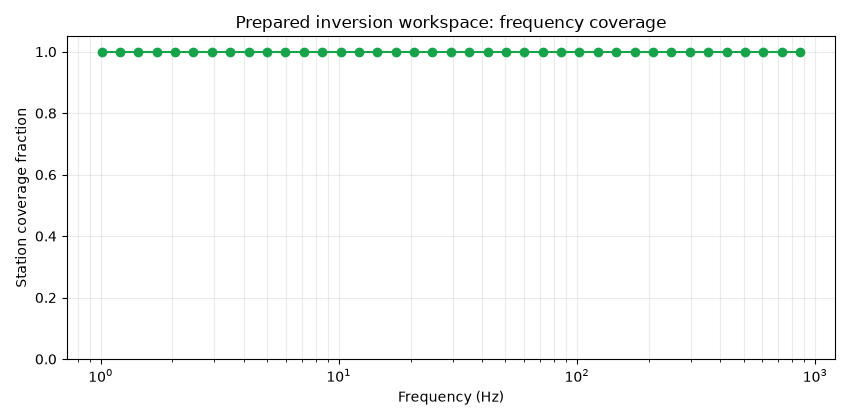
The first figure checks whether every station has enough rows after band selection. The second figure shows frequency coverage across the line.
station_table = station_rows(prepared)
frequency_table = frequency_rows(prepared)

labels = [row["station"] for row in station_table]
nfreq = np.array([row["n_frequency"] for row in station_table], dtype=float)

fig, ax = plt.subplots(figsize=(10.5, 4.0))
ax.bar(np.arange(len(labels)), nfreq, color="#2563eb", alpha=0.85)
ax.set_xticks(np.arange(len(labels)))
ax.set_xticklabels(labels, rotation=90, fontsize=7)
ax.set_ylabel("Frequency rows")
ax.set_title("Prepared inversion workspace: station row counts")
ax.grid(axis="y", alpha=0.25)
fig.tight_layout()
fig.savefig(folders["figures"] / "station_frequency_counts.png", dpi=160)

freq = np.array([row["frequency_hz"] for row in frequency_table], dtype=float)
coverage = np.array(
    [row["coverage_fraction"] for row in frequency_table], dtype=float
)

fig, ax = plt.subplots(figsize=(8.5, 4.2))
ax.semilogx(freq, coverage, "o-", color="#16a34a")
ax.set_xlabel("Frequency (Hz)")
ax.set_ylabel("Station coverage fraction")
ax.set_ylim(0.0, 1.05)
ax.set_title("Prepared inversion workspace: frequency coverage")
ax.grid(True, which="both", alpha=0.25)
fig.tight_layout()
fig.savefig(folders["figures"] / "frequency_coverage.png", dpi=160)
11. Reload the workspace EDIs#
The final sanity check is simple but essential: reload the exported EDIs. If this fails, the inversion handoff is not ready.
reloaded = ensure_sites(folders["edi"], recursive=False, verbose=0)
reload_summary = SitesReport(reloaded).to_dataframe(api=False)

print(f"Reloaded stations: {len(reload_summary)}")
print(
    "Reloaded frequency rows per station: "
    f"{reload_summary['nfreq'].min()}-{reload_summary['nfreq'].max()}"
)

if len(reload_summary) != len(summary):
    raise RuntimeError(
        "Reloaded station count differs from the input station count."
    )
Reloaded stations: 28
Reloaded frequency rows per station: 39-39
12. What comes next?#
This workspace is now ready for backend-specific preparation. The next gallery examples can build on it:
design a starting model and depth grid;
convert
impedance_data_table.csvto a ModEM/Occam data file;validate error floors and dimensionality assumptions;
plot inversion convergence and final sections.
Total running time of the script: (0 minutes 0.874 seconds)