AI inversion#
Deep-learning inversion with pycsamt.ai — training neural networks
to map electromagnetic responses directly to subsurface resistivity,
a fast surrogate for the classical iterative inverters. The gallery builds
from the ground up, 1-D to 3-D and beyond:
Train a 1-D inverter — generate a synthetic training set with the forward solver, fit a CNN, and validate predicted layer models;
Compare architectures — CNN vs ResNet vs FCN on the same data, as a grid of convergence, residual, and per-layer error panels;
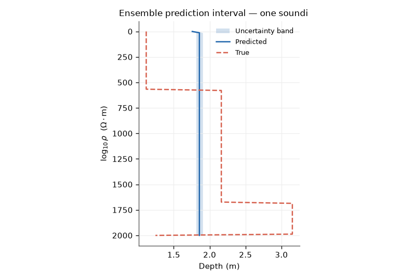
Uncertainty and calibration — deep ensembles, Monte-Carlo dropout, and conformal prediction intervals with coverage diagnostics;
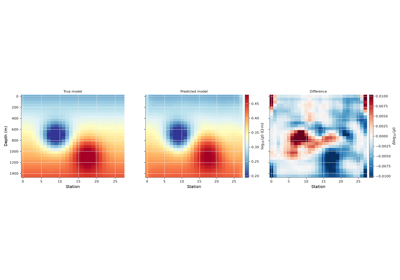
2-D section inversion — a U-Net that predicts a full resistivity cross-section from a pseudo-section of responses;
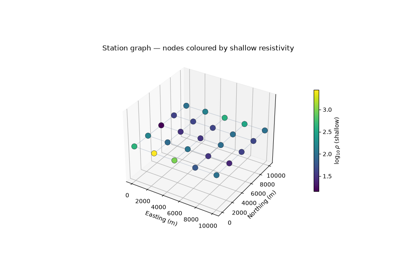
3-D graph-network inversion — a graph convolutional network that inverts a whole multi-line survey at once, using station geometry as graph context.
Every example trains a real network on synthetic data during the documentation build, kept small so each page runs in seconds. On your own data you would use larger training sets and more epochs, but the API and the validation figures are exactly the same. See the AI-inversion user guide for the narrative reference.
Note
These examples require a deep-learning backend (PyTorch or TensorFlow).
Install one with pip install pycsamt[torch].
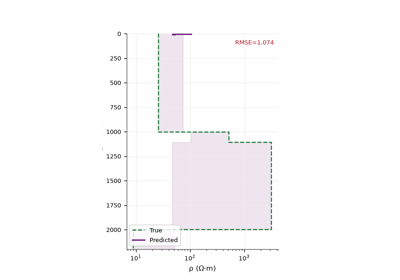
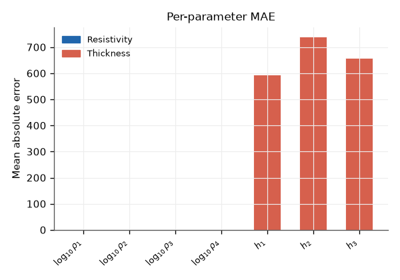
Comparing network architectures (CNN, ResNet, FCN)