
Note
Go to the end to download the full example code.
From IoT edge QC to an MT sounding: a complete acquisition pipeline#
This is an end-to-end study that connects the two halves of pyCSAMT — the
IoT acquisition layer and the geophysical processing engine — on a single
real recording (data/MT/TS/kap103as.ts). The workflow is:
acquire the raw long-period MT time series;
run IoT edge QC (coverage, dropout, resolvable band) and reach an accept/warn decision;
process the accepted recording with
pycsamt.ts.ts_to_z()to recover the impedance tensor, apparent resistivity, and phase;read the classic MT sounding back, with the QC-resolvable band drawn on it so you can see which periods the data actually support; and
emit a provenance trail that ties the raw-file hash to the QC decision, the processing steps, and the written EDI; and
sign the manifest and use the data-model bridge to seed a re-occupation session straight from the EDI just written.
It is the “IoT acquisition feeds directly into the processing pipeline” claim, made concrete on real data.
1. Acquire and QC the raw recording#
The IoT edge layer inspects the raw series before any processing: how complete is it, and over what band is it resolvable?
from __future__ import annotations

import json
import os
import tempfile
from pathlib import Path

import matplotlib.pyplot as plt
import numpy as np
from _ts_sample import load_ts_sample, real_ts_path

from pycsamt.iot import (
    EdgeProcessingConfig,
    EdgeProcessor,
    ProvenanceRecord,
    build_acquisition_manifest,
    detect_sensor_dropout,
    edi_survey_table,
    estimate_frequency_coverage,
    export_reproducibility_bundle,
    field_session_from_edis,
    verify_manifest,
)
from pycsamt.ts import ts_to_edi, ts_to_z

C_XY, C_YX = "#0072B2", "#D55E00"  # Okabe-Ito: two components, two hues
BAND_FILL = "#009E73"


def style_axis(ax: plt.Axes) -> None:
    ax.spines["top"].set_visible(False)
    ax.spines["right"].set_visible(False)
    ax.grid(True, which="both", color="#000000", alpha=0.07, lw=0.7)
    ax.set_axisbelow(True)


ts_path = real_ts_path()
record, ts_is_real = load_ts_sample()
if not ts_is_real:
    print("NOTE: bundled TS recording absent — using a synthetic sample.")
sample_rate = 1.0 / float(record.dt)
channels = [c.lower() for c in record.channels()]

block = np.column_stack(
    [np.asarray(record.get(c.upper()), float) for c in channels]
)
edge = EdgeProcessor(
    EdgeProcessingConfig(finite_threshold=0.9, warn_finite_threshold=0.999)
).process(block, channel_names=channels)
coverage_band = estimate_frequency_coverage(record.get("EX"), sample_rate)
dropout = detect_sensor_dropout(record.get("EX"))

print(
    f"station={record.station}  fs={sample_rate:g} Hz  n={record.n_samples:,}"
)
print(
    f"edge decision: {edge.decision.value}  "
    f"(coverage={edge.metrics['finite_coverage']:.4f}, "
    f"nan={dropout['nan_fraction']:.2%})"
)
print(
    f"resolvable band: {coverage_band.f_low_hz * 1e3:.2f}"
    f"-{coverage_band.f_high_hz * 1e3:.2f} mHz"
)
NOTE: bundled TS recording absent — using a synthetic sample.
station=kap103-synthetic  fs=0.2 Hz  n=65,536
edge decision: accept  (coverage=1.0000, nan=0.00%)
resolvable band: 0.78-22.66 mHz
2. Process the accepted recording to impedance#
Only because edge QC did not reject the recording do we spend compute
on it. ts_to_z estimates band-averaged cross-spectra and recovers the
impedance tensor, apparent resistivity, and phase.
if edge.decision.value == "reject":  # pragma: no cover - QC gate
    raise SystemExit("edge QC rejected the recording; skipping processing.")

z, tipper, spectra = ts_to_z(
    record, nfft=8192, per_decade=6, estimate_error=True
)
freq = np.asarray(z.freq, dtype=float)
period = 1.0 / freq
rho = {"xy": z.resistivity[:, 0, 1], "yx": z.resistivity[:, 1, 0]}
# yx phase is in the third quadrant; bring it to the first (standard MT
# convention, +180 deg) so both curves are comparable.
phase = {"xy": z.phase[:, 0, 1], "yx": z.phase[:, 1, 0] + 180.0}
print(
    f"processed {z.n_freq} frequencies  "
    f"({period.min():.1f}-{period.max():.0f} s period)"
)
processed 17 frequencies (20.0-10240 s period)
3. The MT sounding, annotated with the QC-resolvable band#
Apparent resistivity (log-log) and phase (semi-log) versus period, for the two off-diagonal components. The shaded span marks the band the edge QC deemed resolvable — a direct link from acquisition QC to the periods an interpreter should trust.
p_lo, p_hi = 1.0 / coverage_band.f_high_hz, 1.0 / coverage_band.f_low_hz

fig, (ax_rho, ax_phi) = plt.subplots(
    2,
    1,
    figsize=(8.5, 7.2),
    sharex=True,
    constrained_layout=True,
    gridspec_kw={"height_ratios": [2, 1]},
)
for comp, color in (("xy", C_XY), ("yx", C_YX)):
    good = np.isfinite(period) & np.isfinite(rho[comp]) & (rho[comp] > 0)
    ax_rho.loglog(
        period[good],
        rho[comp][good],
        "o-",
        ms=5,
        lw=1.6,
        color=color,
        label=rf"$\rho_{{{comp}}}$",
    )
    good_p = np.isfinite(period) & np.isfinite(phase[comp])
    ax_phi.semilogx(
        period[good_p],
        phase[comp][good_p],
        "o-",
        ms=5,
        lw=1.6,
        color=color,
        label=rf"$\phi_{{{comp}}}$",
    )

for ax in (ax_rho, ax_phi):
    ax.axvspan(p_lo, p_hi, color=BAND_FILL, alpha=0.10, lw=0)
    style_axis(ax)
ax_rho.set(
    ylabel=r"apparent resistivity ($\Omega\!\cdot\!$m)",
    title=f"MT sounding from IoT-QC'd time series - {record.station}",
)
ax_rho.legend(frameon=False, ncol=2, loc="best")
ax_phi.set(xlabel="period (s)", ylabel="phase (deg)", ylim=(0, 90))
ax_phi.set_yticks([0, 30, 45, 60, 90])
ax_phi.legend(frameon=False, ncol=2, loc="best")
ax_rho.annotate(
    "QC-resolvable band",
    xy=((p_lo * p_hi) ** 0.5, ax_rho.get_ylim()[1]),
    xytext=(0, -14),
    textcoords="offset points",
    ha="center",
    fontsize=9,
    color="#2f7d5b",
)
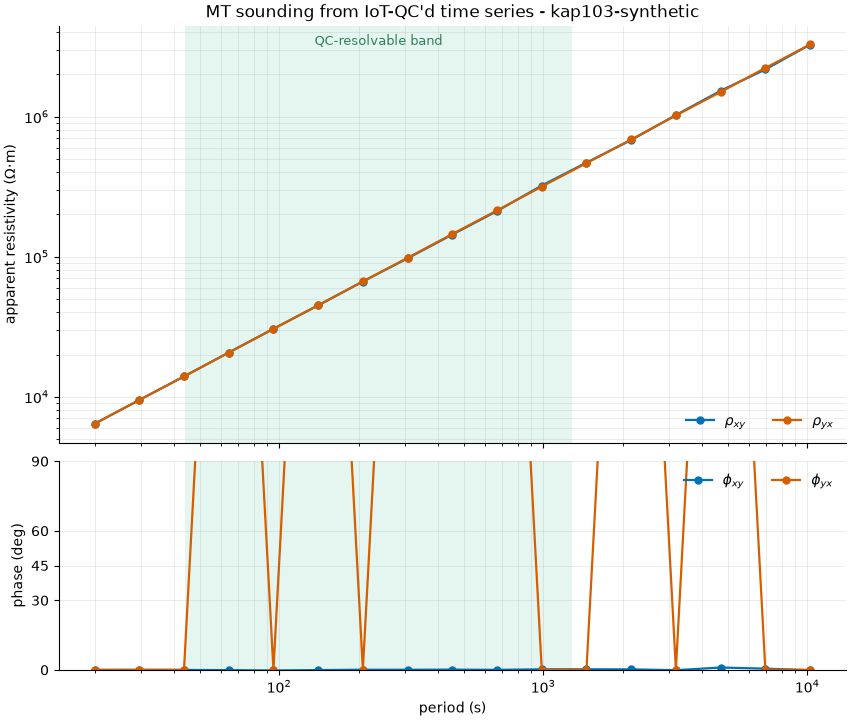
Text(0, -14, 'QC-resolvable band')
4. Write the EDI and a provenance bundle#
The processed result is written to a SEG EDI file, and a provenance manifest records the raw-file hash, the QC decision, the accepted band, and the exact processing steps — a reproducible chain from field bytes to interpreted curve.
out_dir = Path(tempfile.gettempdir()) / "kap103_acquisition"
out_dir.mkdir(exist_ok=True)
edi_path = ts_to_edi(
    record,
    out="kap103_from_ts.edi",
    savepath=str(out_dir),
    nfft=8192,
    per_decade=6,
)
print(
    f"wrote EDI: {Path(edi_path).name} ({os.path.getsize(edi_path):,} bytes)"
)

provenance = ProvenanceRecord(
    station_id=record.station,
    sample_rate_hz=sample_rate,
    lat=record.lat,
    lon=record.lon,
    accepted_band_hz=(coverage_band.f_low_hz, coverage_band.f_high_hz),
    processing_steps=[
        f"iot_edge_qc -> {edge.decision.value}",
        "ts_to_z(nfft=8192, per_decade=6)",
        "resistivity_phase",
        "ts_to_edi",
    ],
    field_notes="Real SAMTEX/LiMS long-period MT series.",
)
if ts_is_real:
    provenance.add_raw_file(str(ts_path))
manifest = build_acquisition_manifest(
    record.station,
    records=[provenance],
    method="mt",
)
bundle = export_reproducibility_bundle(manifest, str(out_dir / "provenance"))
print(f"provenance steps: {provenance.processing_steps}")
print(f"manifest content hash: {manifest.as_dict()['content_hash'][:16]}...")
print(
    f"bundle: {Path(bundle['manifest']).name} "
    f"+ {len(bundle['audits'])} audit(s)"
)
wrote EDI: kap103_from_ts.edi (11,470 bytes)
provenance steps: ['iot_edge_qc -> accept', 'ts_to_z(nfft=8192, per_decade=6)', 'resistivity_phase', 'ts_to_edi']
manifest content hash: 4e64e5b22ab5aeda...
bundle: acquisition_manifest.json + 1 audit(s)
5. Sign the manifest and seed a re-occupation from the EDI#
An HMAC signature makes the audit trail tamper-evident: a reviewer
holding the shared key can confirm the manifest was not altered. Then the
data-model bridge reads the EDI we just wrote back into an IoT
FieldSession, so the station’s recorded geometry is ready to be
re-occupied in a follow-up campaign — closing the loop from acquisition
to data model and back.
key = "survey-key-2026"  # in practice, a per-survey secret
signed_path = manifest.write_signed(
    str(out_dir / "provenance" / "manifest.signed.json"), key
)
signed = json.loads(Path(signed_path).read_text())
print(
    f"signed manifest verifies: {verify_manifest(signed, key)}  "
    f"(wrong key: {verify_manifest(signed, 'nope')})"
)

reoccupy = field_session_from_edis(edi_path, survey_id="REOCCUPY", method="mt")
print(
    f"re-occupation session: {reoccupy.n_stations} station(s), "
    f"{reoccupy.n_devices} node(s)"
)
print(edi_survey_table(edi_path).to_string(index=False))

plt.show()
signed manifest verifies: True  (wrong key: False)
re-occupation session: 1 station(s), 1 node(s)
         station        lat     lon  elevation  n_freq  f_min_hz  f_max_hz    channels  n_channels
kap103-synthetic -32.138889 20.4675        0.0      17  0.000098      0.05 ex;ey;hx;hy           4
Total running time of the script: (0 minutes 0.523 seconds)