
15.1. The EMTF Document#
EMTF is the document-level container for one station’s
transfer functions: one or more named
TransferFunction objects (impedance,
tipper, and anything else registered in the datatype registry) plus
the format-neutral metadata that describes them –
site, provenance,
copyright, site_layout,
orientation, processing,
quality – all covered in Metadata
rather than redefined here. Every public class used on this page
(EMTF, TransferFunction, get_emtf_datatype) imports
directly from the top-level package: from pycsamt.emtf import EMTF,
TransferFunction, get_emtf_datatype. There is no need to reach into
pycsamt.emtf.document or pycsamt.emtf.transfer directly
in ordinary code – those module paths are used here only inside
:class: cross-references, for Sphinx’s benefit, not because the
import path is different in practice.
15.1.1. Loading a Real Document#
The two real stations already used throughout Metadata
– the WILLY L18 EDI line and the Gabbs Valley USGS station gv100
(public-domain USGS data, https://doi.org/10.5066/P9GZ9Z56) – load
into an EMTF the same way regardless of which real-world
processing chain produced the source file:
>>> from pathlib import Path
>>> from pycsamt.emtf import EMTF

>>> tf_willy = EMTF.from_edi(Path("data/AMT/WILLY_DATA/L18PLT/18-001A.edi"))
>>> print(sorted(tf_willy.transfer_functions.keys()))
['impedance']

>>> tf_gv = EMTF.from_edi(Path("data/gv_data/gv_final_edi/gv100.edi"))
>>> print(sorted(tf_gv.transfer_functions.keys()))
['impedance', 'tipper']
>>> print(tf_gv.tags)
('impedance', 'tipper')
WILLY genuinely has no tipper block at all – the source EDI’s
TIP section is absent, not empty – so tf_willy correctly
attaches only an "impedance" transfer function.
tags tracks every transfer-function key
attached so far and is automatically kept in sync by
add_transfer_function().
15.1.2. Retrieving a Transfer Function by Name or Alias#
get_transfer_function() resolves either the
document’s internal key or any alias/short code registered for that
datatype – "Z" and "impedance" both reach the same object,
because the EMTF datatype registry (covered in full in
Transfer Functions and Estimates) defines "Z" as impedance’s short code:
>>> from pycsamt.emtf import get_emtf_datatype

>>> print(get_emtf_datatype("impedance").tag)
impedance

>>> imp = tf_gv.get_transfer_function("impedance")
>>> imp_alias = tf_gv.get_transfer_function("Z")
>>> print(imp is imp_alias)
True
>>> print(imp.data.shape, imp.input_channels, imp.output_channels)
(48, 2, 2) ('Hx', 'Hy') ('Ex', 'Ey')

>>> tip = tf_gv.get_transfer_function("T")
>>> print(tip.data.shape, tip.input_channels, tip.output_channels)
(48, 1, 2) ('Hx', 'Hy') ('Hz',)

>>> print(tf_gv.get_transfer_function("does-not-exist"))
None
A name that matches nothing returns None rather than raising –
useful for an optional-tipper check like if doc.get_transfer_function("T"):
... without a try/except.
15.1.3. Building a Document From Scratch#
Constructing TransferFunction and EMTF objects
directly – rather than loading them from a file – shows the
document’s own consistency rules directly, without an EDI adapter’s
extra layer in between:
>>> import numpy as np
>>> from pycsamt.emtf import TransferFunction

>>> periods1 = np.array([1.0, 10.0, 100.0])
>>> z = np.ones((3, 2, 2), dtype=complex)
>>> tf1 = TransferFunction(
...     name="impedance", data=z,
...     input_channels=("Hx", "Hy"), output_channels=("Ex", "Ey"),
...     periods=periods1,
... )
>>> doc = EMTF()
>>> doc.add_transfer_function(tf1)
EMTF(product_id=None, description=None, subtype=None, tags=tuple(['impedance']), periods=ndarray(shape=(3,), dtype=float64), transfer_functions=dict(len=1, keys=[impedance]), provenance=None, copyright=None, site=None, site_layout=None, orientation=None, processing=None, quality=None, field_notes=dict(len=0, keys=[]), station=None, station_id=None, lat=None, lon=None, elev=None, azimuth=None, metadata=dict(len=0, keys=[]), attrs=dict(len=0, keys=[]))
add_transfer_function() returns self, so
calling it bare in a REPL – as above – echoes the entire document
repr, not just a confirmation. That is deliberate: it makes the call
chainable (EMTF().add_transfer_function(tf1).add_transfer_function(tf2)),
but it also means a script that calls it for a side effect only should
not leave the call bare at module level, or the interpreter will
print the whole document. The repr above is also a convenient map of
every field this page and Metadata cover, all in one
place.
A second transfer function must share the document’s period grid once one is already set:
>>> periods2 = np.array([1.0, 10.0, 200.0])
>>> t = np.ones((3, 1, 2), dtype=complex)
>>> tf2 = TransferFunction(
...     name="tipper", data=t,
...     input_channels=("Hx", "Hy"), output_channels=("Hz",),
...     periods=periods2,
... )
>>> try:
...     doc.add_transfer_function(tf2)
... except ValueError as exc:
...     print(type(exc).__name__, exc)
ValueError period grid for 'tipper' differs from EMTF document

>>> try:
...     doc.add_transfer_function(tf1)
... except ValueError as exc:
...     print(type(exc).__name__, exc)
ValueError transfer function already exists: impedance

>>> _ = doc.add_transfer_function(tf1, replace=True)
tf2’s last period, 200 s instead of 100 s, is enough to reject it
– periods are compared with a tight numerical tolerance, not just
counted. Re-attaching tf1 under its own name fails the same way a
duplicate dictionary key would; replace=True is required to
intentionally overwrite an existing entry, so a typo cannot silently
discard an already-attached transfer function.
15.1.4. Convenience Accessors and Units#
z, tipper,
impedance, and tipper_tf
read straight through to the matching
TransferFunction’s .data. What
they do not do is convert units – a real EDI-derived impedance
stays in the file’s native unit until something explicitly converts
it:
>>> print(imp.units)
[mV/km]/[nT]
>>> print(imp.data[0])
[[ -86.57589 -714.197j 1090.806  +2750.944j]
 [-115.5849 +1316.743j -683.7422 -5020.612j]]
Passing that array straight into an SI-based formula –
rho_phase_from_z(),
skin_depth(), or any other
MTBase method inherited by
TransferFunction – silently produces nonsense: apparent
resistivities in the hundreds of millions of ohm-metres for a real,
unremarkable MT station. The fix is
z_mvk_nt_to_ohms(), which converts the
EDI-native [mV/km]/[nT] convention to SI ohms:
>>> z_si = imp.z_mvk_nt_to_ohms(imp.data)
>>> print(z_si[0])
[[-0.10879447-0.89748642j  1.37074725+3.45693818j]
 [-0.14524827+1.65466805j -0.85921579-6.30908711j]]
z_err follows the same “nothing is fabricated”
rule seen throughout Metadata, applied to
uncertainty instead of metadata:
>>> print(tf_gv.z_err)
None
>>> var_est = imp.get_estimate("variance")
>>> print(var_est.name)
VAR
>>> print(np.sqrt(var_est.data)[0])
[[ 98.57316572 237.08819034]
 [249.77736086 600.78698388]]
The real gv100 file has a VAR (variance) estimate attached to its
impedance, but no STD (standard-error) estimate –
z_err looks specifically for the latter and
returns None rather than silently deriving one by taking the
square root of the variance on the caller’s behalf. That derivation
is one line of NumPy when it is actually wanted, as above, but pycsamt
will not perform it implicitly: a caller who only checked z_err is
not None should not be misled into thinking the file carries no
uncertainty information at all.
15.1.5. A Real Sounding Curve#
The two accessors above are enough to turn tf_gv into a
recognizable magnetotelluric sounding curve, using the same
rho_phase_from_det() determinant
apparent-resistivity/phase method used elsewhere in pycsamt:
import matplotlib.pyplot as plt

z_si = imp.z_mvk_nt_to_ohms(imp.data)
rho_det, phase_det = imp.rho_phase_from_det(z_si, imp.frequency)
periods = imp.periods

fig, (ax_rho, ax_phase) = plt.subplots(
    2, 1, figsize=(6, 6), sharex=True,
    gridspec_kw={"height_ratios": [2, 1]},
)
ax_rho.loglog(periods, rho_det, "o-", color="#1f77b4", ms=4)
ax_rho.set_ylabel(r"Apparent resistivity ($\Omega\cdot$m)")
ax_rho.set_title("gv100 determinant apparent resistivity and phase")
ax_rho.grid(True, which="both", alpha=0.3)

ax_phase.semilogx(periods, phase_det, "o-", color="#d62728", ms=4)
ax_phase.set_ylabel("Phase (deg)")
ax_phase.set_xlabel("Period (s)")
ax_phase.axhline(45, color="grey", lw=0.8, ls=":")
ax_phase.grid(True, which="both", alpha=0.3)
fig.tight_layout()
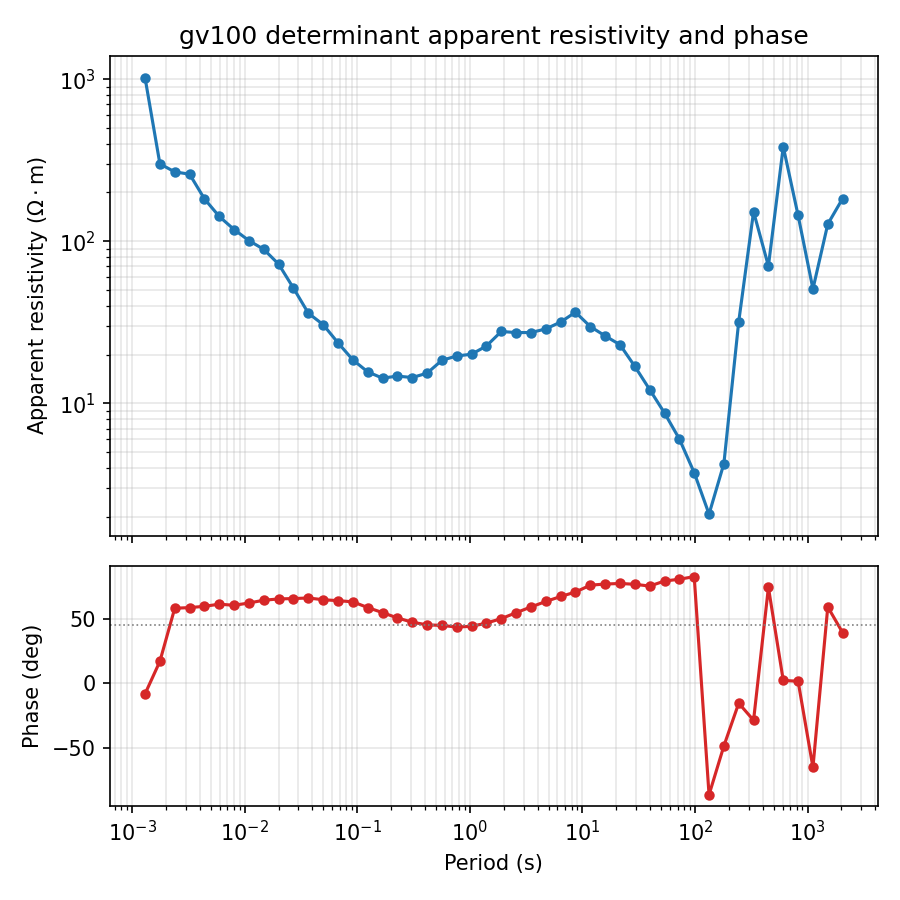
gv100’s real determinant sounding curve: resistivity falls from about 1000 Ω·m at the shortest periods to roughly 15 Ω·m around 0.2-1 s, then rises again toward greater depth before both curves turn erratic beyond about 100 s.#
The short-to-intermediate-period shape is an ordinary decreasing/rising
sounding curve – nothing unusual. The scatter beyond roughly 100 s is
not a plotting artifact, but it is not the same thing as the
PARTIAL tipper coverage (71 %) already found for this station in
Processing and Quality, even though both point at
the same general region of the response. Every impedance value behind
this curve is finite –
DataQuality reported all four Z
components 100 % covered – so the long-period scatter is real,
present, noisy signal, not a missing-data gap. Tipper’s own gaps are a
separate, genuine NaN pattern, and they sit at both ends of the
band rather than only the long-period end:
>>> tip = tf_gv.get_transfer_function("T")
>>> finite = np.isfinite(tip.data.real) & np.isfinite(tip.data.imag)
>>> gaps = np.where(~finite.all(axis=(1, 2)))[0]
>>> print(gaps.size, "of", tip.n_periods, "periods have a NaN tipper value")
14 of 48 periods have a NaN tipper value
>>> print(tip.periods[gaps][:3], "...", tip.periods[gaps][-3:])
[0.0013021  0.00176396 0.00238964] ... [1115.94090334 1511.76950353 2048.00020972]
>>> print(tip.data[gaps[0]])
[[nan+nanj nan+nanj]]
Eleven of the fourteen gaps are at the shortest periods (highest frequencies), and only three at the longest – coverage-based QC (Processing and Quality) and a visual look at the actual values (this curve) are complementary checks that can each surface a different real limitation of the same station, not two views of the same number.
15.1.6. Bridging to TFBundle#
to_bundle() and
from_bundle() connect EMTF to the older,
simpler TFBundle model that pre-dates the
format-neutral metadata layer:
>>> from pycsamt.core.base import TFBundle

>>> bundle = tf_gv.to_bundle()
>>> print(type(bundle).__name__)
TFBundle
>>> print(bundle.z.shape, bundle.tipper.shape)
(48, 2, 2) (48, 2)
>>> print(bundle.station, bundle.lat, bundle.lon, bundle.elev)
gv100 38.611380555555556 -118.53526111111111 1437.4

>>> back = EMTF.from_bundle(bundle)
>>> print(back.z.shape)
(48, 2, 2)
>>> print(back.site)
None
>>> print(back.provenance)
None
The round trip is lossy by design, not by omission. TFBundle has
no field for SiteMeta, ProvenanceMeta, or anything else in
Metadata – it only ever had station/lat/lon/elev
– so EMTF.from_bundle legitimately cannot recover site or
provenance from a bundle that never carried them. This is
documented as “the classical subset” rather than a bug: use
to_bundle/from_bundle for code that only ever needed the
legacy array-plus-coordinates model, and go through EDI or XML
directly (EDI Interoperability, Reading and Writing EMTF XML) whenever the richer metadata
matters.
15.1.7. Legacy Field Conflict Detection#
Site and Survey Metadata already showed EMTF rejecting a
lat value that disagreed with an attached SiteMeta. The same
check runs for every legacy bridge field, including the two identity
fields:
>>> from pycsamt.metadata import SiteMeta, LocationMeta

>>> loc = LocationMeta(latitude=38.6114, longitude=-118.5353, elevation=1437.4)
>>> site_meta = SiteMeta(site_id="gv100", name="Gabbs Valley", location=loc)
>>> tf_ok = EMTF(site=site_meta)
>>> print(tf_ok.station, tf_ok.station_id, tf_ok.lat, tf_ok.lon, tf_ok.elev)
gv100 gv100 38.6114 -118.5353 1437.4

>>> try:
...     EMTF(site=site_meta, station="not-gv100")
... except ValueError as exc:
...     print(type(exc).__name__, exc)
ValueError legacy station conflicts with SiteMeta: 'not-gv100' != 'gv100'

>>> tf_consistent = EMTF(site=site_meta, station="gv100")
>>> print(tf_consistent.station)
gv100

>>> try:
...     EMTF(site=site_meta, station_id="wrong-id")
... except ValueError as exc:
...     print(type(exc).__name__, exc)
ValueError legacy station_id conflicts with SiteMeta: 'wrong-id' != 'gv100'
tf_ok.station reads "gv100" because
SiteMeta.site_id takes priority over SiteMeta.name when both
are set (see the identity-resolution discussion in
Site and Survey Metadata) – the bridge follows exactly the
same precedence, not a separate rule of its own.
15.1.8. Choosing the Right Accessor#
Need |
Accessor |
Notes |
|---|---|---|
Look up a transfer function by name/alias |
|
Returns |
Raw impedance/tipper array |
|
Still in the source format’s native units – check |
Full matrix object, channels, estimates |
|
Use when more than the bare array is needed. |
Legacy standard-error array |
|
Only populated from an explicit |
Interop with pre-EMTF code |
|
Lossy for metadata by design; arrays and legacy fields survive. |
15.1.9. Next Steps#
Transfer Functions and Estimates covers
TransferFunction,StatisticalEstimate, and the datatype registry in full;EDI Interoperability covers what
EMTF.from_edi()extracts from each EDI section, and the lossy return trip;Metadata covers every metadata object
EMTFholds.