
15.6. Rotation and Covariance#
EMTF.rotate (backed by
rotate_emtf() and
rotate_transfer_function()) implements
the general EMTF matrix rotation
\(TF' = V \cdot TF \cdot U^{\mathsf T}\), with
rotate_covariance() applying the
matching transform to inverse-signal and residual covariance factors
when they are present. Rotation is deliberately kept out of every
format reader/writer covered elsewhere in this section: it operates
only on the format-neutral TransferFunction
and EMTF objects, and it never touches
SiteLayout – the physical channel
geometry stays exactly as recorded, while
OrientationMeta (see
Channels and Orientation) is what actually changes.
EMTF, EMTFRotationError, and the warning classes below all
import from the top level; the two matrix-construction functions do
too – from pycsamt.emtf import (EMTF, EMTFRotationError,
horizontal_rotation_matrix, horizontal_inverse_rotation_matrix).
15.6.1. Rotation Matrices#
horizontal_rotation_matrix() builds
the two-channel rotation used at every period. An identity case and a
90-degree case are both exactly analytically checkable:
>>> import numpy as np
>>> from pycsamt.emtf import horizontal_rotation_matrix, horizontal_inverse_rotation_matrix

>>> identity = horizontal_rotation_matrix(0.0, 90.0, 0.0)
>>> print(np.round(identity, 12))
[[1. 0.]
 [0. 1.]]

>>> ninety = horizontal_rotation_matrix(0.0, 90.0, 90.0)
>>> print(np.round(ninety, 12))
[[ 0.  1.]
 [-1.  0.]]
Rotating a pair of channels already at (0°, 90°) to a target of
0° is the identity, as expected; rotating the same pair to a
90° target swaps and sign-flips the axes, also exactly as
expected for a coordinate rotation.
horizontal_inverse_rotation_matrix()
is the matching inverse, verified by composing the two:
>>> minv = horizontal_inverse_rotation_matrix(0.0, 90.0, 30.0)
>>> mfwd = horizontal_rotation_matrix(0.0, 90.0, 30.0)
>>> print(np.allclose(mfwd @ minv, np.eye(2), atol=1e-10))
True
15.6.2. Orientation Must Be Unambiguous First#
Rotation refuses to guess a starting orientation. The real gv100
station (public-domain USGS data,
https://doi.org/10.5066/P9GZ9Z56, already used throughout
Metadata) has orientation.mode unset, exactly as
found in EDI Interoperability, and calling
rotate() on it directly fails
immediately rather than silently assuming a frame:
>>> from pathlib import Path
>>> from pycsamt.emtf import EMTF, EMTFRotationError

>>> tf_gv = EMTF.from_edi(Path("data/gv_data/gv_final_edi/gv100.edi"))
>>> print(tf_gv.orientation.mode)
None
>>> try:
...     tf_gv.rotate(0.0)
... except EMTFRotationError as exc:
...     print(type(exc).__name__, exc)
EMTFRotationError transfer-function orientation is ambiguous; provide source_angles or enable use_legacy_edi_rotation
The real fix is to supply the actual starting azimuth explicitly. The
station’s own SiteLayout, already
used in Channels and Orientation, already records
it – Hx sits at \(-12.5^\circ\):
>>> import warnings

>>> hx = tf_gv.site_layout.get_channel("Hx")
>>> print(hx.orientation)
-12.5

>>> with warnings.catch_warnings(record=True) as caught:
...     warnings.simplefilter("always")
...     rotated = tf_gv.rotate(0.0, source_angles=hx.orientation)
...     print(len(caught), caught[0].category.__name__)
2 ApproximateVarianceRotationWarning
>>> print(rotated.orientation.mode, rotated.orientation.angle_to_geographic_north)
orthogonal 0.0
15.6.3. Approximate Variance vs. Exact Covariance#
The two warnings above are not incidental – they are the direct
consequence of gv100 carrying only a bare VAR estimate (see
The EMTF Document), one warning each for impedance and tipper. Without
both INVSIGCOV and RESIDCOV, VAR cannot be rotated
exactly, and variance_policy controls what happens instead. The
default, "drop", discards it rather than publish a number that
looks precise but is not:
>>> print(rotated.impedance.get_estimate("variance"))
None
"independent" rotates it anyway, under an explicit
independent-component approximation, still with a warning:
>>> with warnings.catch_warnings(record=True) as caught:
...     warnings.simplefilter("always")
...     rotated_indep = tf_gv.rotate(0.0, source_angles=-12.5, variance_policy="independent")
...     print(len(caught))
2
>>> print(rotated_indep.impedance.get_estimate("variance").data.shape)
(48, 2, 2)
and "raise" refuses outright instead of approximating:
>>> try:
...     tf_gv.rotate(0.0, source_angles=-12.5, variance_policy="raise")
... except EMTFRotationError as exc:
...     print(type(exc).__name__, exc)
EMTFRotationError VAR cannot be rotated exactly without both INVSIGCOV and RESIDCOV
The real spectra01 station recovered in EDI SPECTRA Recovery is the
clean contrast: because spectra_to_emtf()
attaches full INVSIGCOV/RESIDCOV alongside VAR, the exact
path applies automatically and rotation produces zero warnings:
>>> doc_spectra = EMTF.from_edi("data/MT/SPECTRA/spectra01.edi")
>>> with warnings.catch_warnings(record=True) as caught:
...     warnings.simplefilter("always")
...     rotated_spectra = doc_spectra.rotate(0.0, source_angles=0.0)
...     print(len(caught))
0
>>> print(rotated_spectra.impedance.get_estimate("variance") is not None)
True
>>> print(rotated_spectra.impedance.get_estimate("inverse_signal_covariance") is not None)
True
INVSIGCOV/RESIDCOV are rotated exactly with
rotate_covariance(), and VAR is
then recomputed from their rotated diagonals rather than rotated
directly – the statistically correct result, not an approximation of
one.
15.6.4. The True Determinant Is Rotation-Invariant#
Individual matrix components change under rotation, but the true
\(2\times2\) determinant of the impedance tensor does not – a
standard MT identity, and one that holds exactly here too, checked
directly with numpy.linalg.det() on real data before and after
the rotation performed above:
>>> det_before = np.abs(np.linalg.det(tf_gv.impedance.data))
>>> det_after = np.abs(np.linalg.det(rotated.impedance.data))
>>> print(np.allclose(det_before, det_after, rtol=1e-10))
True
import matplotlib.pyplot as plt

periods = tf_gv.impedance.periods
zxy_before = tf_gv.impedance.data[:, 0, 1]
zxy_after = rotated.impedance.data[:, 0, 1]

fig, (ax1, ax2) = plt.subplots(1, 2, figsize=(10, 4.2))
ax1.semilogx(periods, np.degrees(np.angle(zxy_before)), "o-", color="#1f77b4", ms=4, label="native (-12.5°)")
ax1.semilogx(periods, np.degrees(np.angle(zxy_after)), "o-", color="#d62728", ms=4, label="rotated (30°)")
ax1.set_xlabel("Period (s)")
ax1.set_ylabel("Zxy phase (deg)")
ax1.set_title("Individual component: changes")
ax1.legend(fontsize=8)

ax2.loglog(periods, det_before, "o-", color="#1f77b4", ms=5, label="native")
ax2.loglog(periods, det_after, "x", color="#d62728", ms=7, mew=2, label="rotated")
ax2.set_xlabel("Period (s)")
ax2.set_ylabel("|det(Z)|")
ax2.set_title("True determinant: unchanged")
ax2.legend(fontsize=8)
fig.suptitle("gv100 impedance before/after rotating -12.5° -> 30°", fontsize=10)
fig.tight_layout()
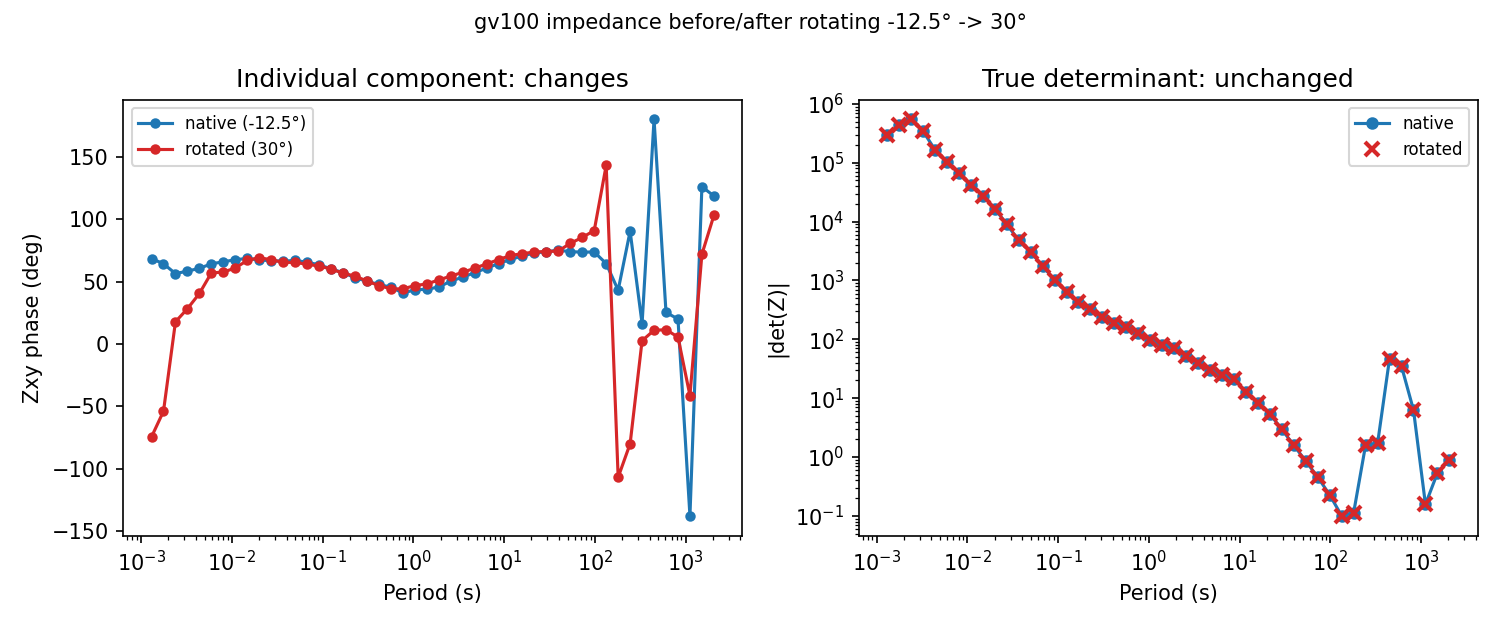
Zxy visibly changes under rotation, most obviously in the noisy
long-period range already seen in The EMTF Document. |det(Z)|
overlaps exactly at every single period, including that same noisy
range – the determinant does not care which orthogonal frame the
matrix happens to be expressed in.#
Note
pycsamt.core.base.MTBase.determinant_z() and
rho_phase_from_det(), inherited by
every TransferFunction, compute the
same invariant shown above directly –
Z_det = sqrt(Zxx Zyy - Zxy Zyx) – as a convenience, without
requiring a manual numpy.linalg.det() call. Building this
exact example is what surfaced a real bug in that formula (it
previously omitted the Zxx Zyy term, so it was only invariant
for a zero-diagonal tensor); it has since been corrected, and the
check above now holds for determinant_z too, verified on this
same real gv100 rotation.
15.6.5. Identity, Round Trip, and the Untouched Site Layout#
Rotating to the frame a document is already in is the identity –
is_identity short-circuits
internally, and the returned data matches exactly:
>>> identity_doc = tf_gv.rotate(-12.5, source_angles=-12.5)
>>> print(np.allclose(identity_doc.z, tf_gv.z, equal_nan=True))
True
Rotating forward and then back reproduces the original values within floating-point tolerance, as a genuine two-step transform (not a special-cased no-op this time):
>>> forward = tf_gv.rotate(0.0, source_angles=-12.5)
>>> back = forward.rotate(-12.5, source_angles=0.0)
>>> print(np.allclose(back.z, tf_gv.z, atol=1e-6))
True
By default rotate() returns a deep
copy – identity_doc.site_layout above is a different, though
numerically identical, object from tf_gv.site_layout.
inplace=True mutates and returns the same document, and in that
mode the original SiteLayout object itself is preserved, not just
its values, because the physical channel geometry must never be
replaced by rotation:
>>> original_layout = tf_gv.site_layout
>>> result_inplace = tf_gv.rotate(0.0, source_angles=-12.5, inplace=True)
>>> print(result_inplace is tf_gv)
True
>>> print(result_inplace.site_layout is original_layout)
True
15.6.6. Legacy EDI Rotation and Rotating Back to Site Layout#
When a document’s orientation is ambiguous but its EDI-derived
rotation_info/extra still carries a historical ZROT
vector – true for the WILLY L18 line used throughout this section –
use_legacy_edi_rotation=True opts into treating that vector as an
orthogonal source frame, with an explicit warning marking it as an
assumption rather than a certainty:
>>> tf_willy = EMTF.from_edi(Path("data/AMT/WILLY_DATA/L18PLT/18-001A.edi"))
>>> with warnings.catch_warnings(record=True) as caught:
...     warnings.simplefilter("always")
...     rotated_legacy = tf_willy.rotate(30.0, use_legacy_edi_rotation=True)
...     for w in caught:
...         print(w.category.__name__)
LegacyRotationAssumptionWarning
ApproximateVarianceRotationWarning
>>> print(rotated_legacy.orientation.mode, rotated_legacy.orientation.angle_to_geographic_north)
orthogonal 30.0
Every rotation appends to orientation.rotation_info rather than
overwriting it, so the history of what happened to a document remains
readable later:
>>> print(rotated_legacy.orientation.rotation_info)
EDI ZROT is constant at 0 deg relative to HEAD.COORDSYS='Geomagnetic North'; it was not promoted to an angle_to_geographic_north because historical EDI rotation metadata can be ambiguous.
pyCSAMT rotated transfer functions to an orthogonal frame at 30 degrees clockwise from geographic north
target="sitelayout" rotates back to the original physical channel
frame instead of an arbitrary orthogonal azimuth, appending one more
line to that same history:
>>> back_to_layout = rotated_legacy.rotate(target="sitelayout")
>>> print(back_to_layout.orientation.mode)
sitelayout
>>> print(back_to_layout.orientation.rotation_info)
EDI ZROT is constant at 0 deg relative to HEAD.COORDSYS='Geomagnetic North'; it was not promoted to an angle_to_geographic_north because historical EDI rotation metadata can be ambiguous.
pyCSAMT rotated transfer functions to an orthogonal frame at 30 degrees clockwise from geographic north
pyCSAMT rotated transfer functions to original site layout
15.6.7. Choosing the Right Option#
Need |
Option |
Notes |
|---|---|---|
Rotate a whole document |
|
Thin wrapper over |
Rotate one transfer function |
|
Same engine, used internally by |
Starting orientation is ambiguous |
|
The latter warns; it is an assumption, not a certainty. |
|
|
|
A rotation-invariant scalar check |
|
Both give the true determinant – see the note above. |
15.6.8. Next Steps#
This closes the current pass through EMTF. From here:
Channels and Orientation covers
OrientationMeta/SiteLayoutas metadata objects in their own right, independent of the rotation engine that changes one and never the other;EDI SPECTRA Recovery covers how full covariance is recovered in the first place, which is what makes the exact rotation path in this page possible;
The EMTF Document and EDI Interoperability cover the
EMTFcontainer and EDI adapter these examples load from.