
16.11. Maxwell Caching And Batch Solving#
Every example so far in this section of the guide has solved one problem at
a time. Maxwell Analytic Benchmarks closed by reusing an already-solved
ForwardResult to check it against two
different threshold policies without re-solving; this page is about the two
modules that make that kind of reuse – and solving hundreds or thousands of
problems reliably rather than one – practical.
MaxwellResultCache never solves the same
problem twice, and solve_batch() turns
one adapter and many problems into a run that survives individual failures
and can resume after a crash. Neither module changes what a
Maxwell adapter computes; both change what happens around it.
16.11.1. Content-Addressed Caching#
MaxwellResultCache is a
content-addressed cache: every entry is keyed by
problem_hash, written by
atomic replacement, and checked against a SHA-256 sidecar on every read.
get_or_solve() is
the one method most callers need: check the cache, and only call the
backend on a miss.
>>> import numpy as np
>>> from pathlib import Path
>>> from tempfile import TemporaryDirectory
>>> from pycsamt.forward.maxwell import (
...     MaxwellMesh, MaxwellProblem, ReceiverSet, MaxwellResultCache,
... )
>>> from pycsamt.forward.maxwell.mt2d import MT2DAdapter

>>> mesh = MaxwellMesh(np.linspace(0, 10_000, 21), np.linspace(0, 5_000, 16))
>>> problem = MaxwellProblem(
...     mesh, np.full(mesh.shape, 0.01), [10.0, 1.0],
...     ReceiverSet([[5_000.0, 0.0]], ["S00"]), ("zxy", "zyx"),
... )
>>> adapter = MT2DAdapter(verbose=False)
>>> directory = TemporaryDirectory()
>>> cache = MaxwellResultCache(directory.name)
>>> cache.contains(problem)
False
>>> result = cache.get_or_solve(problem, adapter)
>>> cache.contains(problem)
True
>>> stats = cache.statistics()
>>> stats.entry_count, stats.orphan_count, stats.corrupt_count
(1, 0, 0)
>>> stats.total_bytes > 0
True
Calling get_or_solve again for the identical problem returns the cached
entry without touching adapter at all – the whole point when a Maxwell
solve, not the cache lookup, dominates the cost of generating a dataset or
re-running an experiment. CacheEntry
exposes the same information without deserializing the archive:
>>> entry = cache.entry(problem.problem_hash)
>>> entry.size_bytes > 0, entry.checksum_path.name.endswith(".sha256")
(True, True)
>>> len(cache.entries())
1
16.11.2. Corruption And Quarantine#
A result archive can be damaged by a crashed write, a full disk, or manual tampering, and the cache never trusts one on faith. Deliberately corrupting the stored archive shows what a validated read actually does:
>>> archive, checksum = cache._paths(problem.problem_hash)
>>> with open(archive, "r+b") as stream:
...     _ = stream.seek(0)
...     _ = stream.write(b"\x00\x00\x00\x00")
>>> cache.get(problem) is None
True
>>> cache.statistics().to_dict()
{'entry_count': 0, 'total_bytes': 0, 'orphan_count': 0, 'corrupt_count': 2}
The default quarantine_corrupt=True moves both the archive and its
checksum sidecar under root/corrupt and reports the read as a miss –
get returning None looks identical to a problem that was simply
never solved, which is deliberate: a caller using get_or_solve recovers
automatically by recomputing. A cache built with quarantine_corrupt=False
instead raises CacheCorruptionError
and leaves the damaged files in place for inspection, which is the setting
worth choosing while diagnosing why entries are turning up corrupt rather
than routing around it in production:
>>> from pycsamt.forward.maxwell.cache import CacheCorruptionError
>>> with TemporaryDirectory() as strict_directory:
...     strict_cache = MaxwellResultCache(strict_directory, quarantine_corrupt=False)
...     _ = strict_cache.get_or_solve(problem, adapter)
...     bad_archive, _ = strict_cache._paths(problem.problem_hash)
...     with open(bad_archive, "r+b") as stream:
...         _ = stream.seek(0)
...         _ = stream.write(b"\x00\x00\x00\x00")
...     try:
...         strict_cache.get(problem)
...     except CacheCorruptionError as exc:
...         print(exc)
result archive checksum mismatch.
16.11.3. Pruning A Cache#
A long-running cache directory grows without bound unless something removes
old entries. prune()
removes the oldest entries, by modification time, until the remaining
archive-plus-checksum storage fits a byte budget:
>>> directory2 = TemporaryDirectory()
>>> budget_cache = MaxwellResultCache(directory2.name)
>>> station_problems = [
...     MaxwellProblem(
...         mesh, np.full(mesh.shape, 0.01), [10.0, 1.0],
...         ReceiverSet([[x, 0.0]], ["S00"]), ("zxy", "zyx"),
...     )
...     for x in (2_000.0, 5_000.0, 8_000.0)
... ]
>>> for station_problem in station_problems:
...     _ = budget_cache.get_or_solve(station_problem, adapter)
>>> budget_cache.statistics().entry_count
3
>>> removed = budget_cache.prune(maximum_bytes=0)
>>> len(removed)
3
>>> removed[0].key == station_problems[0].problem_hash
True
>>> budget_cache.statistics().entry_count
0
A budget of zero removes everything, but always in the same order: oldest
modification time first, so removed[0] is the entry solved first above,
not necessarily the one with the smallest archive. A larger, nonzero budget
stops removing as soon as the remaining entries already fit – it is a
storage cap, not an instruction to remove any particular count.
16.11.4. Solving Many Problems At Once#
solve_batch() applies one backend to
many problems and reports a
BatchReport, whether or not a cache
is involved:
>>> from pycsamt.forward.maxwell.batch import solve_batch, BatchPolicy

>>> stations_x = [2_000.0, 4_000.0, 6_000.0, 8_000.0]
>>> problems = [
...     MaxwellProblem(
...         mesh, np.full(mesh.shape, 0.01), [10.0, 1.0],
...         ReceiverSet([[x, 0.0]], [f"S{i:02d}"]), ("zxy", "zyx"),
...     )
...     for i, x in enumerate(stations_x)
... ]
>>> directory3 = TemporaryDirectory()
>>> run_cache = MaxwellResultCache(directory3.name)
>>> first_report = solve_batch(problems, adapter, cache=run_cache)
>>> first_report.total, len(first_report.solved), len(first_report.cache_hits)
(4, 4, 0)
>>> second_report = solve_batch(problems, adapter, cache=run_cache)
>>> second_report.total, len(second_report.solved), len(second_report.cache_hits)
(4, 4, 4)
Nothing about problems or adapter changed between those two calls –
only whether run_cache already had each answer. That is the resumability
the module docstring promises: rerunning the exact same batch, in a new
process if needed, after first_report already ran is what
second_report demonstrates, and it is exactly what a training-dataset
generation script restarted after a crash relies on, cache directory
unchanged, to avoid resolving problems it already finished.
16.11.5. Retries And Terminal Failures#
Not every raised exception deserves a retry, and
BatchPolicy treats the two cases
differently by design: a transient failure such as
BackendExecutionError gets max_attempts tries with backoff between
them, while a deterministic IncompatibleProblemError – the exact error
Maxwell Adapters raised earlier for a receiver off the surface – is
recorded immediately, because retrying it would just fail the same way
every time:
>>> good = [
...     MaxwellProblem(
...         mesh, np.full(mesh.shape, 0.01), [10.0, 1.0],
...         ReceiverSet([[x, 0.0]], [f"S{i:02d}"]), ("zxy", "zyx"),
...     )
...     for i, x in enumerate([2_000.0, 8_000.0])
... ]
>>> buried = MaxwellProblem(
...     mesh, np.full(mesh.shape, 0.01), [10.0, 1.0],
...     ReceiverSet([[5_000.0, 50.0]], ["BAD"]), ("zxy", "zyx"),
... )
>>> seen = []
>>> mixed_report = solve_batch(
...     good + [buried], adapter, on_failure=lambda p, f: seen.append(f.error_type),
... )
>>> len(mixed_report.solved), len(mixed_report.failed)
(2, 1)
>>> seen
['IncompatibleProblemError']
>>> failure = mixed_report.failed.failures[0]
>>> failure.attempts, failure.error_type
(1, 'IncompatibleProblemError')
>>> buried in mixed_report.failed
True
on_failure (and its counterpart on_result) fire in completion order
as each problem finishes, which is what a script streaming results straight
into a growing dataset archive should use instead of waiting for the whole
batch and iterating the report afterward.
FailureManifest is built to be
archived, not just inspected in-process:
>>> from pycsamt.forward.maxwell.batch import FailureManifest
>>> manifest_dir = TemporaryDirectory()
>>> manifest_path = Path(manifest_dir.name) / "failures.json"
>>> _ = mixed_report.failed.to_json_file(manifest_path)
>>> restored = FailureManifest.from_json_file(manifest_path)
>>> restored == mixed_report.failed
True
A future run can load that manifest, subtract restored.hashes from a new
problem list, and retry only what previously failed – or, just as
importantly, choose not to retry a documented, understood failure and keep
a record of exactly which realizations were excluded and why, rather than
letting them quietly vanish from a training distribution.
16.11.6. Stopping Early#
Some runs should not continue past the first failure at all –
BatchPolicy(stop_on_first_failure=True) turns that failure into a raised
BatchAbortedError carrying the
partial report instead of returning normally:
>>> from pycsamt.forward.maxwell.batch import BatchAbortedError
>>> try:
...     solve_batch(good + [buried], adapter, policy=BatchPolicy(stop_on_first_failure=True))
... except BatchAbortedError as exc:
...     exc.report.total, len(exc.report.solved), len(exc.report.failed)
(3, 2, 1)
This is the right default for a controlled synthetic-recovery experiment,
where one unexplained failure should stop the run rather than get buried in
a manifest alongside hundreds of successes; the default
stop_on_first_failure=False is the right one for a large campaign where
a handful of documented failures are an acceptable, auditable cost of
coverage.
16.11.7. Concurrency And Backend Identity#
BatchPolicy.max_workers runs solves concurrently in a thread pool, and
the module docstring is explicit that this only helps when the backend
actually releases Python’s GIL while it works. Measuring both kinds of
backend on the same machine makes that concrete rather than theoretical:
View concurrency-comparison source codeClick to inspect and copy the complete code
 1def make_concurrency_comparison() -> dict[str, float]:
 2    mt2d_mesh = MaxwellMesh(np.linspace(0, 10_000, 41), np.linspace(0, 5_000, 31))
 3    mt2d_adapter = MT2DAdapter(verbose=False)
 4    mt2d_problems = [
 5        MaxwellProblem(
 6            mt2d_mesh, np.full(mt2d_mesh.shape, 0.01), np.geomspace(1000, 1, 8),
 7            ReceiverSet([[x, 0.0]], [f"S{i:02d}"]), ("zxy", "zyx"),
 8        )
 9        for i, x in enumerate(np.linspace(1000, 9000, 8))
10    ]
11
12    n, h = 8, 300.0
13    modem_mesh = MaxwellMesh(np.arange(n + 1) * h, np.arange(11) * h, np.arange(n + 1) * h)
14    modem_adapter = ModEm3DAdapter()
15    modem_problems = [
16        MaxwellProblem(
17            modem_mesh, np.full(modem_mesh.shape, 1.0 / 100.0), [1.0, 0.5],
18            ReceiverSet([[n * h / 2, n * h / 2, 0.0]], [f"S{i:02d}"]), ("zxy", "zyx"),
19            metadata={"case": i},
20        )
21        for i in range(6)
22    ]
23
24    timings = {
25        "mt2d_seq": _timed_batch(mt2d_problems, mt2d_adapter, 1),
26        "mt2d_par": _timed_batch(mt2d_problems, mt2d_adapter, 4),
27        "modem3d_seq": _timed_batch(modem_problems, modem_adapter, 1),
28        "modem3d_par": _timed_batch(modem_problems, modem_adapter, 4),
29    }
30
31    fig, ax = plt.subplots(figsize=(8, 5), constrained_layout=True)
32    groups = ["MT2DAdapter\n(8 in-process solves)", "ModEm3DAdapter\n(6 external-process solves)"]
33    sequential = [timings["mt2d_seq"], timings["modem3d_seq"]]
34    parallel = [timings["mt2d_par"], timings["modem3d_par"]]
35    x = np.arange(len(groups))
36    width = 0.35
37    ax.bar(x - width / 2, sequential, width, label="max_workers=1", color="#457b9d")
38    ax.bar(x + width / 2, parallel, width, label="max_workers=4", color="#e76f51")
39    for i, (s, p) in enumerate(zip(sequential, parallel)):
40        ax.annotate(f"{s / p:.2f}x", (x[i], max(s, p) * 1.03), ha="center", fontsize=10)
41    ax.set_xticks(x)
42    ax.set_xticklabels(groups)
43    ax.set_ylabel("wall-clock time (s)")
44    ax.set_title("solve_batch concurrency: in-process GIL vs. external subprocesses")
45    ax.legend()
46    _save(fig, "maxwell_caching_and_batch_concurrency.png")
47    return timings
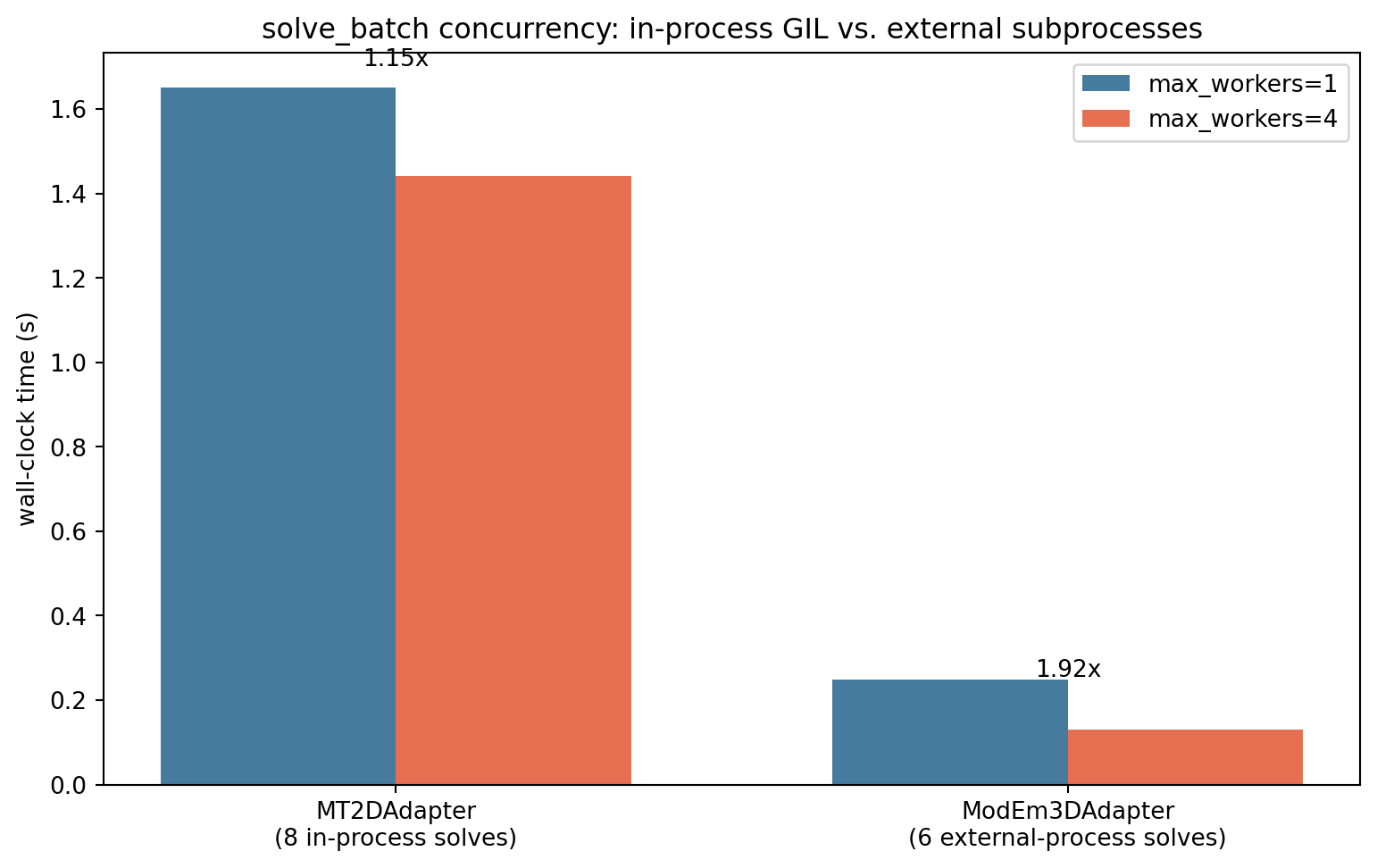
Sequential versus four-worker wall-clock time for eight in-process
MT2DAdapter solves and six external-process ModEm3DAdapter
solves on the same machine.#
MT2DAdapter solves in-process against SciPy’s sparse solver, and four
workers barely help: Python still serializes most of the work through the
GIL, so the measured speedup is modest. ModEm3DAdapter solves by
launching a separate Mod3DMT process per problem – entirely outside the
GIL – and four workers measurably approach the throughput four independent
processes should give. Neither number is a promise for a different machine,
mesh size, or executable; it is exactly the kind of claim
Maxwell Analytic Benchmarks argues should be measured on the system that will
actually run the batch, not assumed from a general rule about threads.
Every worker sharing one MaxwellResultCache
still solves correctly under concurrency: the per-key lock inside
get_or_solve ensures two workers racing on the identical problem never
both solve it, and the loser of that race simply reads back what the winner
just wrote.
16.11.8. Common Mistakes#
Assuming get_or_solve is free after a corrupt readA quarantined entry becomes a cache miss, not an error – the next
get_or_solvecall transparently re-solves and re-writes it. That recomputation cost is real even though nothing raises.Sharing one cache directory across backend versionsThe cache key is
problem_hashalone; it does not include backend name or version.get_or_solve(problem, adapter_v2)can silently return a result computed byadapter_v1if both wrote into the same cache root. Use a separate cache root, or checkresult.backend_versionexplicitly, when comparing solver versions.Treating stop_on_first_failure as safe with max_workers > 1With concurrency,
stop_on_first_failureonly stops further submissions once a failure is observed; problems already dispatched to other workers still run to completion. The returned report can contain more solved problems than the position of the first failure would suggest.Retrying a wrapped deterministic bug foreverBaseMaxwellAdapterwraps ordinary exceptions raised inside a solve intoBackendExecutionErrorby default, which is inBatchPolicy’s defaultretry_on. A genuine bug in backend code can therefore look like a transient failure and burn every retry attempt before finally being recorded – build the adapter withwrap_backend_exceptions=Falsewhile debugging a suspected code bug rather than a flaky external process.Deleting a cache directory to fix a lock timeoutA
CacheLockTimeoutErrormeans another process may genuinely be computing the same key, or a stale lock was left behind by a crash. Investigate the specific lock file underroot/locksrather than clearing the whole cache, which throws away every other valid entry along with it.
16.11.9. Next Pages#
Maxwell Problem, Mesh, And Result Contracts and Maxwell Solver Meshes cover the problem,
mesh, and result contracts this page’s examples built directly rather than
loaded from a mesh workflow – worth reading next for how those same
problems are normally constructed from real geology instead of a few
np.linspace calls.